Heavy Copper PCB Flatness: What to Declare in the RFQ Before Warpage Becomes a Dispute
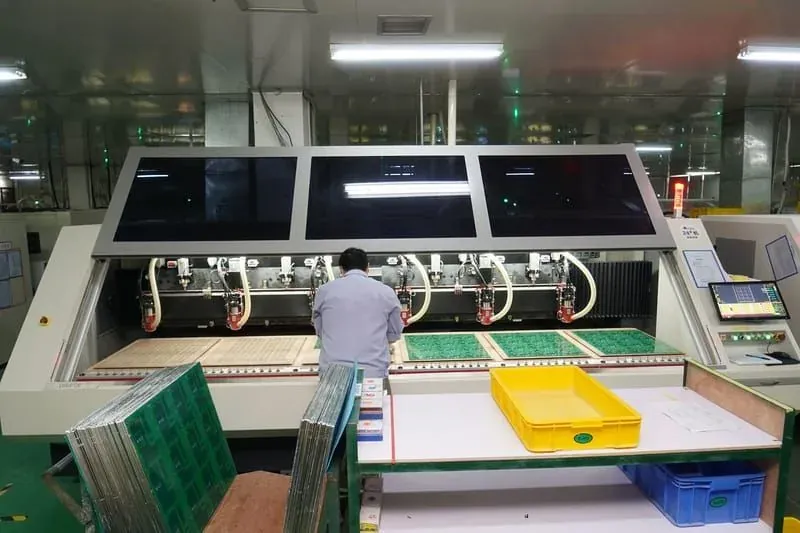
The board arrives with a shape, and nobody wrote down which shapes are acceptable
A heavy copper board arrives, the assembly line clamps it, and the stencil will not seat. Or the board seats fine but the print is thin along one edge. Or it passes print and comes out of reflow with joints open on the side that lifted. Someone walks back through the paperwork looking for the flatness clause, and there is no flatness clause. There is a thickness tolerance, a copper weight, a surface finish, a laminate callout, and a line that says boards shall be free from visual defects.
That gap is not an oversight about a minor attribute. On heavy copper, flatness is produced by the same thing that produces the product: thick asymmetric copper, long etch and plate cycles, and a lamination history that puts far more energy into the stack than a standard two-ounce build ever sees. The board does not arrive flat by default and then warp because something went wrong. It arrives with whatever shape the process gave it, and the only question is whether anyone wrote down which shapes are acceptable.
Meanwhile the assembly side is running on an assumption nobody stated. Fixturing assumes the board will sit against its supports. Paste printing assumes the stencil will contact the pads with even pressure. Pick and place assumes nozzle travel lands where the vision system expects. Reflow assumes the board does not change shape enough to pull joints. Every one of those steps has a flatness requirement, and in most purchase orders not a single one of them is expressed as a number, a condition, or a method.
What this article answers
This is a purchasing document, not a warpage theory paper. It covers five things:
- Which RFQ field actually carries flatness, and why "per standard practice" hands the decision to whoever measures last.
- Why two parties measuring the same board reach different conclusions when the measurement condition is unstated, and which condition does the damage.
- The four items a flatness judgement must specify before it is enforceable: measurement state, support method, sampling locations, and the point in time at which the reading counts.
- The disposition path and cost ownership when incoming boards fall outside whatever was agreed, including the case where nothing was agreed.
- The design-side inputs that change achievable flatness, which therefore have to travel with the quote request rather than appearing later as a surprise.
What it does not do is tell you what number to ask for. Any figure here would be a fabricated capability claim, and a flatness limit that is not matched to your own assembly process is just a different arbitrary number. The useful output is a declaration structure you fill in with values your assembly side can defend.
Flatness is a delivery attribute, and the paperwork usually treats it as cosmetics
Three parts of a typical specification set touch board shape, and none of them governs it.
Visual acceptance. Clauses about the absence of defects were written for things a person can see and name: scratches, exposed copper, solder mask voids, silkscreen legibility. Shape is not in that family. A board can be measurably out of plane and have no visible defect at all. Putting flatness under visual acceptance means it gets inspected by someone who is not measuring it, against a criterion that does not exist.
Dimensional tolerance. Outline, hole position, and finished thickness are dimensional, and heavy copper work usually has real tolerances on all three. But thickness is a through-the-board measurement at a point. A board can be perfectly in thickness tolerance at every point and still be a saddle or a bow. Thickness and flatness are independent attributes, and satisfying one says nothing about the other.
Workmanship language. General phrases about good commercial practice are the most common place flatness implicitly lives, and the least useful. They do not define a quantity, a method, or a threshold. Their practical effect is to make the attribute non-adjudicable: both parties can point at the same clause and reach opposite conclusions, which is exactly what happens when boards get rejected and the rejection is contested.
So the attribute exists, matters to the next process, and has no field. The consequence is structural rather than accidental: when a quantity has no declared owner, the party who measures first after delivery becomes the de facto owner, and the party who built the board had no target to hit. Both sides behaved reasonably and the outcome is still a dispute.
Why heavy copper changes the stakes
On a thin, symmetric, low-copper board, flatness is usually a non-issue because the process naturally lands well inside what assembly can absorb. Several things about heavy copper move it out of that comfortable zone at once.
Copper distribution is rarely symmetric. Heavy copper designs exist because something needs to carry current or move heat, and those features are local: a bus, a plane segment, a thermal pad region. The result is a build with substantially different copper mass on different layers and in different areas of the same layer, which means the stack has no reason to be balanced.
The thermal history is longer and harder. Thick copper takes more processing to etch and plate, and the lamination cycle has to move more material to fill around tall features. More energy and more cycles mean more opportunity for the stack to settle into a shape.
The stiffness is high. This is the counterintuitive one and it matters most at assembly. A thin board that is out of plane can often be flattened by the fixture. A thick heavy copper board resists being flattened. Whatever shape it holds is the shape the printer and the placement head have to work with, and clamping harder does not fix it so much as load the board.
And the assembly consequences land on the operations that have the least tolerance for a gap: stencil contact, which depends on the board surface being where the aperture is, and reflow, where a board that moves during the cycle can open joints that printed and placed correctly.
None of this is a defect narrative. It is the reason flatness has to be a stated and priced requirement on heavy copper instead of a residual assumption carried over from thinner work.
Why two honest measurements disagree
Before any threshold is worth negotiating, the measurement has to be reproducible between two organisations. Flatness is unusual among purchasing attributes in that it is not a property of the board alone. It is a property of the board plus the conditions under which it is read. Change the conditions and the number changes, with no change in the board.
This is the mechanism behind most incoming-inspection disputes on heavy copper, and it is worth being precise about, because it explains why "we measured it and it's out" and "we measured it and it's fine" can both be true statements.
The board is not in one state. A panel is not a shipped board. A board immediately after depanelisation is not the same as one that has sat for a week. A board at room temperature is not the same as one that has been through a thermal cycle. Each of these is a legitimate moment to measure, and they do not agree with each other. If the specification does not say which moment counts, each party measures at whichever moment is natural to their own workflow, and their workflows are at different points in the board's life.
The support condition sets the answer. This is the single largest source of divergence. A board laid on a flat surface under its own weight gives one reading. The same board held at its corners gives another. The same board constrained in the assembly fixture gives a third, and that third one is often much better than the other two, because the fixture is doing work. None of these is wrong. They answer different questions. The supplier's question is usually "what shape did we produce"; the assembler's question is usually "what shape will I have to print onto". Those are different questions and they deserve different support conditions, but only one of them can be the contractual one.
The sampling location decides what the number describes. A single reading at the worst point and an average across a grid are different statistics about the same board. Edge-only sampling misses a centre dome entirely. Centre-only sampling misses edge lift, which is the mode that actually breaks stencil contact. Without declared locations, each side samples where its own concerns live, finds what it was worried about, and concludes the other side is being unreasonable.
The reading convention is not universal. Whether a deviation is expressed against the board's own dimension, against an absolute height, or as an overall departure from a reference plane changes the magnitude of the number even when the physical board is identical. Two parties can agree on the measurement and still disagree on the figure.
The practical takeaway: a flatness limit stated as a bare number is not a specification. It is the smaller half of one. The number is only meaningful once the four conditions below are attached to it, and attaching them costs nothing at RFQ time and is nearly impossible to do retroactively once a shipment is in dispute.
The four items a flatness requirement must specify
These four are the minimum set that makes a flatness clause enforceable. They are not a standard; they are the fields without which the clause cannot be adjudicated. Fill each one in with a value your assembly process can defend, and require the supplier to confirm it can be met before the order is placed rather than after the boards ship.
1. Measurement state
Declare the physical state of the article at the moment of measurement. At minimum this covers whether the reading is taken on the delivered single board or on the panel, whether it is taken as received or after any conditioning, and whether any thermal exposure precedes the reading.
This matters because the state determines whose problem the result describes. A panel reading describes the fabrication output. A reading on the delivered board as received describes what the assembler will actually unpack. A reading after a thermal exposure describes what will happen during reflow, which is the state the assembler actually cares about and the one that is hardest for the supplier to control or verify.
The decision to make explicit: if your real concern is behaviour during reflow, say so, and accept that this is a harder requirement to place on a fabricator than a room-temperature as-received reading. Asking for the easy measurement and then rejecting on the hard one is the most common bad-faith-looking move in this area, and it is usually not bad faith at all, just an undeclared state.
2. Support method
Declare how the board is supported while being read. Free-standing on a reference surface under its own weight, supported at specified points, or constrained in a defined fixture are three different requirements, and the gap between the first and the third can be large on a stiff heavy copper board.
The supplier cannot reproduce your fixture, so a fixture-constrained criterion is generally only workable as an assembly-side acceptance condition, not a fabrication-side one. The usable pattern is to specify a free or point-supported condition as the delivery criterion, and separately tell the supplier what the assembly fixture does, so the criterion can be set with knowledge of the margin it needs to leave.
3. Sampling locations
Declare where the readings are taken and how many. Three choices need making: whether sampling is on a declared grid or at named worst-case features, whether edges are included and how close to the edge, and whether the criterion applies to the maximum single reading or to some aggregate.
Name the locations that correspond to your actual process risks. If stencil contact at the board perimeter is what fails, the perimeter has to be in the sample set. If the failure mode is a dome under a large thermal feature, that region has to be named. A grid chosen for convenience will reliably miss the mode you care about, because process-driven shape is not uniformly distributed, it concentrates where the copper asymmetry is.
4. Point in time at which the reading counts
Declare when the measurement has contractual force: at the supplier's outgoing inspection, at your incoming inspection, or both with a defined reconciliation procedure if they disagree.
This is the item most often left out and the one that decides every dispute. Boards can change shape in transit and in storage. If only outgoing inspection counts, the assembler absorbs any change after shipment. If only incoming counts, the supplier carries a risk it cannot observe. If both count, there must be a written path for what happens when the two readings differ, and the obvious candidates are re-measurement under the declared conditions, a third-party reading, or an agreed precedence rule.
Also declare how long the incoming result stands. A board accepted on arrival and assembled two months later is a different article from the one that was accepted, and whether that drift is anyone's liability should be a decision rather than an argument.
The declaration block, assembled
Written out, the four items make a single compact clause that can be dropped into an RFQ, repeated in the PO, and referenced in the quality agreement:
- State: measured on [delivered board / panel], [as received / after declared conditioning], [with / without] prior thermal exposure.
- Support: [free on reference surface / supported at declared points / constrained in fixture per attached drawing].
- Sampling: [grid of N positions / named features listed below], edges [included to X of the perimeter / excluded], criterion applies to [maximum single reading / declared aggregate].
- Timing: binding at [supplier outgoing / buyer incoming / both], reconciliation on disagreement by [declared procedure], incoming result valid for [declared period].
- Limit: [value your assembly process can defend], expressed as [declared convention].
The bracketed values are yours to set. The structure is the part most RFQs are missing, and it is the part that converts flatness from an argument into a check.
Which field carries it, and what each document can actually enforce
Having a declaration is not the same as having it in a place where it binds. The same text has different force depending on which document carries it, and heavy copper flatness needs to appear in more than one.
The RFQ is where it has to appear first. Not because the RFQ is binding, but because it is the only moment when the requirement can still change the price. A flatness condition introduced after quoting is a change in scope, and the supplier is entitled to treat it as one. Put in the RFQ at a minimum: the four declaration items, the limit, and a request that the supplier confirm the criterion is achievable on this specific design rather than in general. That last clause is the valuable one, because it moves the feasibility question before the order instead of after the first shipment.
The purchase order is where it binds commercially. The PO is what the invoice references and what a rejection is argued against. Flatness that lives only in an email thread or only in a drawing note that the PO does not invoke is weak. The PO should either carry the declaration block or reference a revision-controlled document that does, with the revision number written out.
The fabrication drawing is where the fabricator's own people will look. Purchasing documents are often not what reaches the process engineer. A note on the drawing, at the specific revision called out by the PO, is what has the best chance of reaching the person who decides how the panel is built and how it is inspected.
The quality agreement is where the process around it lives. Disposition routes, cost ownership, reconciliation on disagreement, re-measurement procedure, and the validity period for an incoming result are process terms, not product terms. They belong in the quality agreement or an equivalent standing document, because they should not be renegotiated per order.
The failure pattern worth naming: a flatness number in the RFQ, nothing in the PO, nothing on the drawing, and no disposition language anywhere. That configuration looks like the requirement was communicated, and it is approximately unenforceable.
Disposition and cost ownership when boards arrive out of tolerance
Decide this before the first rejection, because deciding it during the first rejection means deciding it under schedule pressure, which reliably produces whichever answer is fastest rather than whichever is right.
The dispositions that exist
Reject and replace. The clean path. Requires that the criterion was declared, that incoming measurement reproduces the declared conditions, and that lead time can absorb a rebuild. Most often blocked by the third condition rather than the first two.
Accept with a process change on the assembly side. Additional fixturing, modified print parameters, or a change in handling. This is frequently the real outcome. It has a cost, that cost is real, and it lands on the buyer's side by default unless the agreement says otherwise.
Accept under concession for this shipment only. Workable if it is written as a one-time concession with an explicit statement that the criterion is unchanged for subsequent orders. Without that statement, concessions become the new baseline by precedent, which is how a declared limit quietly stops existing.
Rework. Treat claims that an out-of-plane heavy copper board can be returned to flat with caution, and require that any rework method be declared and agreed in advance rather than applied and then disclosed. A board that has been through an undeclared flattening step is a board whose other properties you now know less about.
Partial acceptance by sorting. Measure the lot, use what passes, return the rest. Needs the sampling plan and the measurement conditions already declared, otherwise sorting is just re-litigating the criterion one board at a time.
Who pays for what
Four cost buckets, each of which should have a named owner in the agreement rather than being resolved case by case:
- Rebuild cost for boards outside a declared criterion. Normally the supplier's, provided the criterion and its conditions were declared before the order.
- Incoming measurement cost, including any third-party reading used for reconciliation. Commonly the buyer's as a routine cost, with the losing party bearing the cost of a contested reconciliation. Both halves of that need writing down.
- Assembly-side mitigation cost when boards are accepted and the line has to compensate. This is the bucket most often left unassigned, and it is the one that actually recurs. If the agreement is silent, it sits with the buyer regardless of who produced the shape.
- Schedule cost from a rebuild. Rarely recoverable in practice. The realistic mitigation is not a liability clause but a first-article flatness reading before the full build, which is cheap to request and is the single highest-value item in this article if you only adopt one.
The case where nothing was declared
If there is no criterion, there is no rejection basis, and the strong position is the supplier's. Boards that meet every stated requirement are conforming boards. The buyer's remaining options are a commercial negotiation with no technical footing, absorbing the mitigation cost, or both.
The correct response is not to argue the current shipment harder. It is to declare the criterion for the next order, and to accept that the current one is a cost already incurred. Trying to apply an undeclared requirement retroactively damages the supplier relationship and usually fails anyway, which is the worst available combination.
Design-side inputs that change what flatness is achievable
Flatness is not purely a fabrication output. Several design decisions bound what any supplier can deliver, which means they have to travel with the RFQ. A supplier quoting without them is quoting a flatness criterion it cannot assess.
Copper distribution across layers and across each layer. This is the dominant input. A build with heavy copper concentrated on one side or in one region has an inherent tendency to a shape, and no process choice fully removes it. Send the actual copper layout, not a summary.
Stack-up symmetry. Whether the construction is symmetric about the centre, and whether copper weights are mirrored, changes the baseline substantially. If symmetry was sacrificed for a routing or thermal reason, say so, because that tells the supplier the asymmetry is not negotiable and the flatness criterion has to be set around it.
Board outline, aspect ratio, and cutouts. Long narrow boards and boards with large internal cutouts have less inherent resistance to shape in specific axes. A criterion that is reasonable on a compact board may not be reachable on a long one of the same construction.
Finished thickness relative to copper weight. The ratio between total thickness and the copper being carried affects how much the structure resists the shape it wants to take. This is a ratio question, not a thickness question, and it is why a flatness limit cannot be copied between designs.
Panelisation and depanelisation method. How boards sit in the panel, the rail design, and how they are separated all affect the delivered single board even when the panel was acceptable. If flatness is specified on the delivered board, panelisation is in scope for the discussion.
Surface finish and any added thermal exposure. Processes that add a thermal cycle after the board has taken shape are part of the flatness history. If a finish choice is still open, it is relevant to this conversation.
Known assembly constraints. Tell the supplier what the board has to do next: the support condition in your fixture, whether the board is printed on both sides, and whether there is a second thermal pass. A supplier that knows the downstream constraint can tell you which criterion is tight and which is comfortable, and that is information you cannot generate on your own.
Sending these with the RFQ converts the quote from a price on a shape-agnostic board into a price on a board with a stated flatness obligation. The second one costs more to quote and far less to receive.
Where this sits relative to the adjacent purchasing questions
Flatness is one field among several that heavy copper purchase documents commonly leave implicit, and keeping the boundaries clean prevents a single clause from being asked to do four jobs.
Finished thickness tolerance is a separate attribute, measured through the board at a point, and satisfying it tells you nothing about shape. Mechanical strength relative to copper weight is a structural question about what the board withstands in service, not about the shape it arrives in. General purchase-specification and acceptance scope is the parent document that should contain this clause among others. Panel allowances for marked-out boards are a yield and count question, independent of the shape of the boards that ship.
This article addresses one thing only: how flatness is declared, measured, judged, and paid for. If your purchase documents are missing several of these fields, the declaration block above is the cheapest one to add first, because it is the only one whose absence can stop an assembly line on the day the boards arrive.
Before you place the order
Five items, all of which cost nothing at RFQ time:
- Write the four declaration items into the RFQ alongside a limit your assembly process can defend. A number without the four conditions is not a specification.
- Ask the supplier to confirm achievability on this design, not in general. Get the answer before the PO.
- Request a first-article flatness reading under the declared conditions before the full build. Highest value per unit of effort of anything here.
- Repeat the declaration in the PO and on the drawing at a called-out revision. RFQ-only requirements are not enforceable requirements.
- Put disposition and the four cost buckets in the quality agreement, especially assembly-side mitigation cost, which is the one that silently defaults to you.
If you want the heavy copper construction itself reviewed against these inputs, start from the heavy copper PCB product page and send the copper layout and stack-up with your quote request. For assembly-side constraints that drive the flatness criterion, the PCB assembly page covers what to state about the downstream process, and capabilities outlines what to ask a supplier to confirm in writing before the order.
FAQ
Is heavy copper PCB warpage a defect or a delivery attribute?
A delivery attribute. On heavy copper the shape is produced by the same asymmetric copper distribution and extended thermal history that produce the product itself, so the board does not start flat and then fail. It arrives with whatever shape the process gave it. That makes flatness something to declare, measure, and price like any other delivered property, not something to inspect against a visual defect clause. It only becomes a defect once there is a declared criterion it misses.
Which RFQ field should carry the flatness requirement?
Flatness needs its own declared clause; it does not live correctly in any existing field. Visual acceptance language does not define a quantity. Finished thickness tolerance is a through-the-board measurement at a point and is satisfied independently of shape. General workmanship phrasing is non-adjudicable. Add a dedicated block covering measurement state, support method, sampling locations, binding timing, and the limit, then repeat it in the PO and on the fabrication drawing at a called-out revision.
Why do our incoming measurements disagree with the supplier's?
Because flatness is a property of the board plus the conditions of the reading, and the conditions are almost never declared. The largest divergence comes from support method: a board free on a reference surface, supported at points, and constrained in an assembly fixture give three different readings for the same physical board. Measurement state is the second source, since a panel, an as-received board, and a board after thermal exposure are different articles. Sampling location is the third, because process-driven shape concentrates where the copper asymmetry is rather than distributing evenly.
What should a flatness clause specify beyond the number?
Four items, without which the number cannot be adjudicated. Measurement state: delivered board or panel, as received or after conditioning, with or without prior thermal exposure. Support method: free, point-supported, or fixture-constrained. Sampling: declared grid or named features, whether edges are included, and whether the criterion applies to the worst single reading or an aggregate. Timing: whether supplier outgoing or buyer incoming inspection binds, how disagreement is reconciled, and how long an incoming result stands.
Who pays when heavy copper boards arrive out of flatness tolerance?
It depends on whether a criterion with its conditions was declared before the order. If it was, rebuild cost is normally the supplier's. Incoming measurement is usually a routine buyer cost, with contested reconciliation borne by the losing party. Assembly-side mitigation cost, when boards are accepted and the line compensates with extra fixturing or modified print parameters, is the bucket most often left unassigned and it defaults to the buyer. Schedule cost from a rebuild is rarely recoverable, which is why a first-article reading before the full build is worth more than a liability clause.
Can an out-of-plane heavy copper board be reworked flat?
Treat such claims with caution and require that any flattening method be declared and agreed in advance rather than applied and then disclosed. A stiff heavy copper board resists being returned to plane, and a board that has been through an undeclared flattening step is a board whose other properties you now know less about. If rework is on the table, it belongs in the disposition section of the quality agreement with a defined method, not as an improvised response to a rejection.
What do we have to send with the RFQ for a supplier to assess flatness?
The actual copper layout across and within layers, the stack-up including whether it is symmetric and whether copper weights are mirrored, the board outline with aspect ratio and any large cutouts, finished thickness relative to the copper being carried, intended panelisation and depanelisation method, surface finish if still open, and your downstream assembly constraints including what the fixture does and whether there is a second thermal pass. Without these a supplier is quoting a shape-agnostic board and cannot tell you which criterion is tight.
We already shipped and there was no flatness clause. What now?
The strong position is the supplier's: boards meeting every stated requirement are conforming boards. Applying an undeclared requirement retroactively usually fails and damages the relationship, which is the worst combination available. Treat the current shipment as a cost incurred, absorb or negotiate the mitigation commercially, and spend the effort on declaring the criterion and its four conditions for the next order, plus a first-article reading before the next full build.
Does flatness need to be re-measured if boards are stored before assembly?
Decide it explicitly. Boards can change shape in transit and in storage, so a board accepted on arrival and assembled months later is not the same article that was accepted. The declaration should state how long an incoming result stands and whether re-measurement is required after a defined storage period. Leaving this unstated means the question gets answered during a schedule crisis, by whoever is arguing hardest.
Is a fixture-constrained flatness criterion reasonable to put on a fabricator?
Generally not as a delivery criterion, because the supplier cannot reproduce your fixture. The workable pattern is a free or point-supported condition as the contractual delivery criterion, plus a separate disclosure of what your assembly fixture does so the limit can be set with knowledge of the margin it needs to leave. If behaviour under fixture constraint or during reflow is the real concern, state that explicitly rather than specifying the easy measurement and rejecting on the hard one.
---
Need PCBs for Your Project?
Get an instant quote — prototypes from $2, delivered worldwide.
Get Instant Quote