Choosing an HDI PCB Supplier: Capability Is Not Capacity Allocation
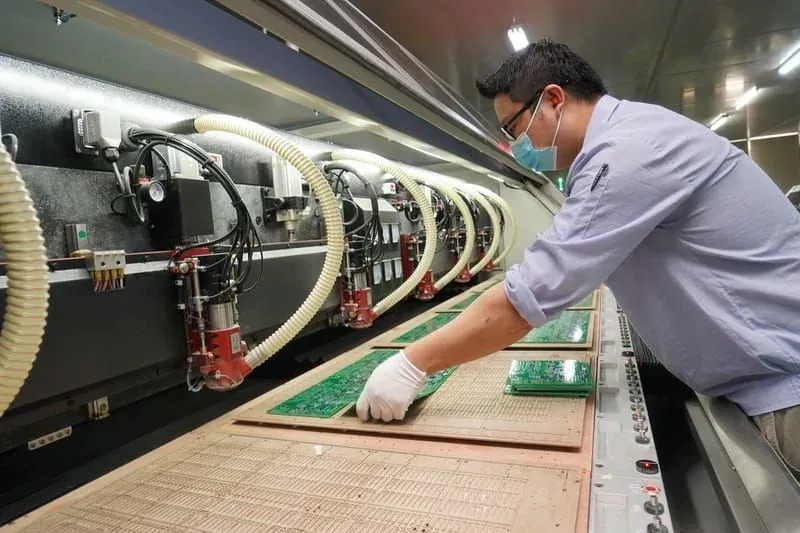
The sample passed, and you drew the wrong conclusion from it
The sequence is familiar. You issue an HDI inquiry, three or four suppliers quote, you build samples at two of them. Two weeks later the boards come back: electrical test passes, cross-sections look clean, impedance lands inside the window. Conclusion: both can build this. Now compare price and lead time.
There is a substitution buried in that conclusion. You verified process feasibility, and you used it to answer a question about supply risk. On conventional multilayer those two overlap enough that the shortcut usually survives. On HDI they come apart.
Be precise about what the sample earned. A passing HDI sample proves this supplier's process window opens on your specific parameters — the laser can drill your via diameter, the via bottom cleans up well enough to plate, registration after sequential lamination stays inside tolerance, fill and plating come through without voiding. That is real evidence and worth having.
But consider the conditions under which it was produced. Prototype lots run at tiny quantities, under non-standard scheduling priority, and frequently as insert jobs. The engineering attention a prototype receives is not the attention your production lot gets when it enters the scheduling system on an ordinary Tuesday morning. The sample proved this plant *can build the board under favorable conditions*. It did not — and structurally cannot — prove that *a block of time in the next six weeks belongs to you*.
That second statement is the one that decides whether you hit your delivery date. And almost nobody asks about it during supplier selection, because it sounds like a post-PO concern.
Why HDI queues differently from conventional multilayer
To see why slot allocation is an independent risk, compare the routing.
A conventional multilayer board runs roughly: inner layers → one lamination → drill → plate → outer layers → solder mask → surface finish → profile and test. The equipment sequence is essentially one-directional. Each machine appears once in the board's life.
Sequential-build HDI does not work that way. Its structure is cyclical. One build-up layer requires one lamination, one laser drill pass, one plating cycle. A second build-up layer requires another lamination, another laser drill pass, another plating cycle. The panel returns to the same press and the same laser driller repeatedly before it ships.
This affects queuing in two ways.
First, occupancy multiplies. A two-build-up panel queues twice at the laser driller and two to three times at the press. The rough arithmetic of "panel count ÷ machine output" does not transfer. For the same order quantity, HDI consumes bottleneck time at a multiple of conventional work.
Second, the queuing is serial and cannot be parallelized. The second build-up cannot start until the first build-up's plating finishes. If one cycle misses its window, everything downstream shifts — there is no parallel catch-up path. A panel stuck in the laser drill queue will be late to its second lamination by construction. In a cyclical routing, delays accumulate rather than absorb.
Layer on one more reality: laser drillers and vacuum presses are typically among the lowest-count, highest-capital assets in the plant, and they serve every HDI order in the building simultaneously. So HDI slot availability is not an averaged "how much capacity remains" question. It is a question about who owns a specific machine's queue during specific weeks.
That is the reason slot allocation needs separate verification. On conventional multilayer, asking "what is the lead time" largely completes the inquiry. On HDI you still need to ask where your panel sits in the queue.
Four different things "we have capacity" can mean
When a supplier says they have capacity, they may be stating any of four distinct facts. The risk implications differ sharply. In an email they look identical.
| What they are actually saying | What you hear | Where the risk sits |
|---|---|---|
| The equipment is capable of this | They can build it | Zero commitment. This restates the sample result |
| Overall loading is not full right now | They have room | Loading is dynamic. The week you order may already be filled by someone else — and they were telling the truth when they said it |
| Output has been reserved for this order class | I have a slot | Closer to useful, but "this order class" is a pool, and you are not the only one in it |
| A specific window is reserved for this P/N, this lot | It is scheduled | This is the only binding version, and it must be in writing |
The work of supplier selection is moving the supplier's answer from the first three rows to the fourth. The ones who will not move are not necessarily disqualified — but you need to know which row you actually hold, and decide about a backup source accordingly.
Note the criterion. It is not how enthusiastic the supplier sounds; it is whether they will be specific. A plant that declines to reserve a named window may simply be accurate — the schedule genuinely is not set yet. That is worth more than an unconditional verbal yes. What you are screening out is vague commitment, not conservative suppliers.
Four things to verify before you single-source
All four can be completed before you award. None requires an on-site audit or disclosure of commercial confidences. The operating principle: ask about structure, not ceilings; ask about ownership, not numbers.
1. How many times does this board occupy the bottleneck
Ask the supplier to walk your build structure: how many passes at the laser driller, how many at the press, and which step must complete between passes. A supplier who can answer has scheduled against your actual structure. A supplier who answers "we have plenty of capacity" has not.
This is not a request for capacity data. It confirms you and the supplier agree on the process-step count for the same board. If their count is lower than you expect, you probably have a build-definition mismatch — and that is a more urgent problem than slot availability.
2. Which document revision the schedule is based on
A slot commitment has to be tied to a specific revision. If Gerbers are still moving, the stack-up is open, or impedance targets are unconfirmed, any date is a date against assumptions. Ask directly: what freeze date does this schedule assume? If files arrive a week late, does the schedule shift by a week, or does the lot re-enter the queue at the back?
Those two outcomes are not close to each other, and the distinction is usually left unstated. File delay triggering requeue rather than shift is the most common hidden lead-time blowout on HDI projects, because once bottleneck time is released it gets filled, and the next opening may be far away.
3. What form the slot is held in
From weakest to strongest: verbal confirmation → emailed scheduling week → written capacity reservation with an expiry → PO placed, loaded into the scheduling system, with a work order number.
Know which tier you hold, and know what it takes to move up. Usually it takes placing a PO or a deposit — which is reasonable, since reserving bottleneck time has an opportunity cost for the supplier. The point is that this exchange has to be clear before you make the award decision, not after you have already committed a date downstream.
4. What releases the slot, and when you find out
This is the one most often skipped and the one worth the most. Ask:
- Which events trigger rescheduling? (Common ones: raw material arrival delay, upstream rework, higher-priority order insertion, unplanned equipment maintenance.)
- When rescheduling happens, does your lot go to the back of the queue, or keep its priority and take the next opening?
- What is the notification obligation: how long after the supplier confirms a change, to whom, and does the notice have to include a new projected window?
That last item matters most. Schedule slippage is a production reality and no contract removes it. But *slippage happening while you learn about it three weeks later* is an information-flow problem, and clauses do solve those. Writing a notification obligation does not buy you fewer delays. It buys you not discovering them passively.
Contract language that makes a slot binding
Four clause structures, with amounts and day counts left for your actual commercial terms:
Reservation and expiry
> Supplier confirms reservation of output time at the [process step] station in [year-week] for P/N [number], lot quantity [qty]. The reservation assumes [document revision] frozen as of [date]. Reservation is valid until [date]; a PO issued by Buyer before that date converts the reservation to a firm schedule. After that date the reservation lapses and both parties must re-confirm a window.
Queue position and treatment after rescheduling
> Where rescheduling of this lot results from [listed events], Supplier shall preserve the lot's existing priority in the [process step] queue and insert it at the next available window, and shall not move it to the end of the queue. This clause does not apply to rescheduling caused by Buyer, including document revision changes and Buyer-supplied material delay.
Notification obligation
> Within [X] working days of confirming any change to this lot's schedule, Supplier shall notify Buyer's named contact in writing. The notice shall state the cause of the change, the affected process steps, the revised projected completion window, and whether the final delivery date is affected.
Treatment of file delay
> If Buyer does not freeze [document revision] by the agreed date, the schedule shall be handled as follows: [shift by the equivalent number of days / re-confirm an available window]. The parties expressly select [chosen option] for this circumstance.
The purpose of these clauses is not litigation. It is surfacing the supplier's real scheduling position before you sign. How a plant reacts to "shall not move it to the end of the queue" — accepts it, asks for conditions, or says it cannot be done — tells you more about its scheduling reality than any capability deck.
Asking the right question: three ineffective questions and their replacements
| Ineffective | Why it fails | Effective |
|---|---|---|
| "How much HDI capacity do you have?" | Returns a number you cannot verify and cannot put in a contract | "How many passes does this board make at the laser driller and the press? Which week does this lot take its first pass?" |
| "Can you guarantee on-time delivery?" | Returns "yes," which carries no information | "Which events move this schedule? How soon do I hear about it when one does?" |
| "How many machines do you have?" | Machine count is not your slot, and most plants will not answer it accurately | "Will you write this lot's reserved window, with an expiry date, into the order acknowledgement?" |
The pattern: change the question from "how much do you have" to "what is allocated to my lot." The first asks about the supplier's totals, which they have every reason to present favorably. The second asks about one specific arrangement that has to land on paper, where there is far less room to be vague.
The short version
HDI supplier selection has two gates. The first is capability, and a sample clears it. The second is slot allocation, and a sample cannot clear it. The second gate is only cleared by writing down, before you award, three things: where this lot sits in the queue, who can move it, and who tells you when they do. Capability verification tells you who you can work with. Slot verification tells you whether you can commit this delivery date downstream — and that is the question actually in front of you.
To package requirements into schedulable inputs (build structure, document freeze date, lot quantity and window), check the declaration items against the HDI PCB product page and submit them through the quote request. Process scope and verifiable items are described under manufacturing capabilities; for deciding where the HDI-versus-conventional build boundary sits, see the multilayer PCB page. Scheduling clauses and notification terms can be confirmed with engineering and commercial via contact.
FAQ
Q1: If a supplier builds a good sample, shouldn't production scheduling be fine too?
There is no causal link. A passing sample proves the process window opens, which is real evidence. But prototype lots run at tiny quantities, under special priority, often as insert jobs. The treatment your production lot receives in the scheduling system is a different thing. Capability and slot allocation need separate verification.
Q2: A supplier won't reserve a named window. Is that a red flag?
Not necessarily, and possibly the opposite. If the schedule genuinely is not set, saying "I can't commit a specific window yet" is accurate. The pattern to worry about is the other one: verbal agreement to everything, but unwillingness to put any of it into an order acknowledgement. You are screening out vague commitment, not conservative suppliers.
Q3: Why is HDI slot risk higher than conventional multilayer?
Because the build is cyclical. One build-up layer costs one lamination, one laser drill pass, one plating cycle; two layers cost two of each. The panel returns to the same laser driller and press repeatedly, and those are typically the lowest-count assets in the plant. The queuing is also serial — the second build-up waits on the first build-up's plating — so a missed window shifts everything after it rather than being absorbed.
Q4: If files are a week late, is delivery a week late?
That is exactly what the contract has to state. The two treatments diverge sharply: shift by the equivalent days, or re-enter the queue for the next available window. On a bottleneck machine the second can mean far more than a week, because the released time gets filled by other work. Unstated, it tends to resolve in whatever direction is convenient, and you have no basis to argue.
Q5: Should a capacity reservation cost money?
Holding bottleneck time for you has an opportunity cost, so reservations are commonly tied to a PO or deposit. That is a reasonable exchange. The issue is not whether you pay — it is that the exchange has to be clear before you make the award decision. Being told a payment is needed to hold the window after you have already committed a date downstream removes your options.
Q6: Of the rescheduling clauses, which one matters most?
The notification obligation. Slippage is a production reality that contracts cannot eliminate; learning about it three weeks late is an information-flow failure that clauses can fix. Specify the working-day window after a confirmed change, the named recipient, and the requirement that the notice include a revised projected window. What that clause preserves is your time to act.
Q7: At what stage should these questions be asked?
Before award, in parallel with price comparison. Asked after the PO, you have no leverage — switching now costs a new sample build plus a new queue position. Asked before sampling, it is early, because the build structure is not fixed and the supplier cannot compute occupancy. The right window is after the sample passes and before you award.
Q8: Only one supplier can build this board. Is verification still worth doing?
More so. With a single source you have no switching option, so the only available move is knowing the real situation early. Pinning down the scheduling basis, the rescheduling triggers and the notification obligation gives you accurate information for commitments you make downstream, plus lead time to react when something moves. Here verification is not leverage, it is planning.
---
Need PCBs for Your Project?
Get an instant quote — prototypes from $2, delivered worldwide.
Get Instant Quote