Heavy Copper PCB Laminate and Tg: What to Declare Before Someone Else Decides
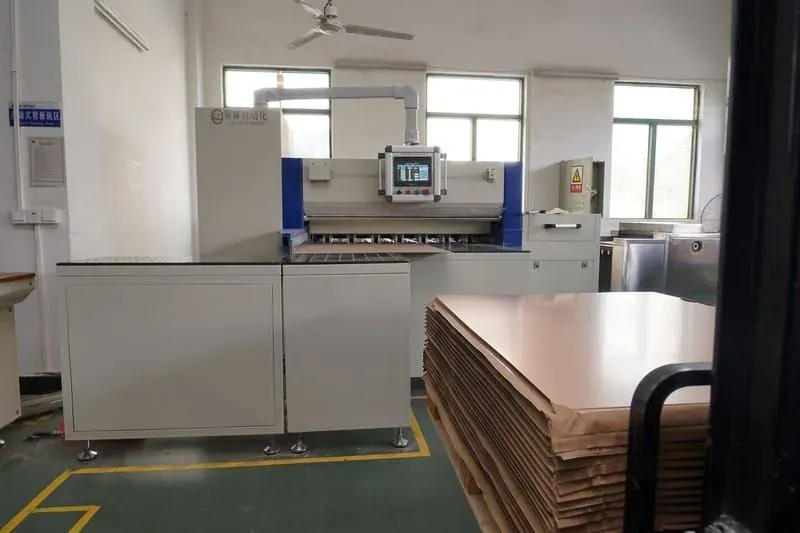
You specified the copper. You specified the layer count, the finished thickness, the finish, the trace widths you could get away with. Then, on the material line, you wrote FR-4.
That line is the one that gets decided for you.
On a standard 1 oz board, "FR-4" is a tolerable shorthand. The resin demand is low, the thermal history is unremarkable, and most of what sits behind that word will behave similarly enough that the shorthand survives. On a heavy copper board it stops being shorthand and becomes an open field. Thicker copper means more resin has to flow into deeper gaps during lamination, and it means the panel carries more thermal mass through every heated step that follows. Both of those things interrogate the laminate directly. A material chosen for low cost and easy flow on thin-copper work may be the wrong answer here, and nothing in your drawing said otherwise.
So the supplier fills the field. Not maliciously — a quoting engineer who receives "FR-4" and a 3 oz stackup has to assume *something* to produce a price, and the assumption that wins is usually whichever qualified material is already on the floor, already priced into the quote, and already proven on that line. That is a reasonable engineering decision made with incomplete information. It is also a decision you did not participate in, cannot see in the quote, and will discover later.
Later is the problem. Base material substitutions are almost never caught at incoming inspection, because the board looks right and measures right. They surface at elevated operating temperature, during rework heating, in a downstream assembly thermal process, or in a qualification test somebody runs eighteen months in. By then the part is shipping.
This article is about one field. Not the whole purchase specification — the purchase specification and acceptance evidence guide covers that end to end. Not copper weight, which we assume you have already settled; if you have not, finished copper thickness versus base copper in the PO declaration is the one to read first, because the material question only makes sense once the copper number means something unambiguous. Here we take copper weight as a fixed input and ask the next question down: what do you say about the laminate, and how much detail is the right amount?
Why copper weight pulls the material decision upward
Three mechanisms connect copper weight to laminate choice. None of them are exotic, and all three are invisible on a finished board.
Resin has further to travel
Etched copper leaves gaps. The dielectric above it has to fill those gaps during lamination, flowing down the full height of the copper and out across the open areas. Double the copper height and the resin has roughly double the depth to fill, in the same press cycle, through the same window.
That changes what you need from the material. Resin content, flow characteristics, and glass style all matter more than they did at 1 oz, and the comfortable choice for thin-copper work — a lower-resin, dimensionally stable build — may simply not have enough resin available to fill cleanly. Under-fill shows up as voids adjacent to the copper edges or as resin-starved corners, and it shows up *inside* the board where nothing in a visual or electrical check is looking.
This is why heavy copper constructions often lean on higher-resin-content prepregs, multiple prepreg plies, or specific glass styles in the layers adjacent to the thick copper. Which combination applies to your board depends on copper weight, how much copper area versus open area there is, and the stackup as a whole. It is an engineering determination, not a catalogue lookup, and it is one of the reasons two suppliers can return genuinely different material lines for the same drawing.
The board carries more thermal mass
Copper conducts heat well and stores a lot of it. A heavy copper panel takes longer to come up to temperature, holds heat longer, and distributes it differently than a thin-copper panel of the same outline. Every heated step after lamination inherits that: solder mask cure, the finish process, assembly reflow, wave or selective soldering if the design uses it, and rework.
The consequence for material selection is that the laminate's resistance to repeated thermal excursions matters more than the headline temperature number most people reach for. Thermal decomposition behaviour and delamination resistance under repeated heating are the properties doing the work here, and they are not the same property as Tg even though they are often discussed in the same breath.
Expansion mismatch gets louder
Copper and resin expand at different rates when heated. That mismatch exists on every board, but its effect scales with how much copper there is and how it is distributed. On heavy copper designs, and especially on mixed-weight stackups where thick and thin layers sit in the same board, the internal stress during thermal cycling is larger and less symmetric.
Mixed-weight constructions have their own submission problem, which heavy copper multilayer mixed-weight stackup RFQ inputs handles. For material purposes the point is narrower: an asymmetric copper distribution raises the value of a material with well-controlled expansion behaviour, and it raises the cost of getting the material wrong.
Tg is not the single number you think it is
"High Tg" is the phrase buyers reach for when they want to signal that the application is demanding. It is better than silence, and it is not sufficient.
Glass transition temperature marks where the resin changes from a relatively rigid state to a softer, more rubbery one. Above it, mechanical and dimensional behaviour changes character. That is genuinely useful to know, and it is why Tg grade is a legitimate thing to declare.
But Tg does not tell you how the material behaves during *repeated* heating, or at what point the resin begins to decompose rather than merely soften, or how resistant the construction is to delamination after several reflow cycles. Those are separate characteristics with separate measurement bases. A material can carry a respectable Tg grade and still be the wrong choice for a board that will see multiple assembly thermal cycles plus field rework.
For heavy copper work the practical reading is:
- Tg grade tells you where softening behaviour begins. Declare it.
- Thermal decomposition behaviour tells you about resistance to sustained or repeated high temperature. Ask about it when the application warrants.
- Delamination resistance under repeated thermal cycles is what actually protects a thick-copper, high-thermal-mass board through assembly and rework. This is the one most often omitted from a buyer declaration and most often relevant.
Declaring "high Tg" alone and assuming it covers all three is the most common version of a half-filled material field. It narrows the supplier's assumption space without closing it.
A note on numbers: specific Tg values, decomposition temperatures, and cycle counts belong to the datasheet of whatever material is actually selected, and to engineering confirmation against your stackup. We are not going to assert figures here, and you should be sceptical of any supplier who quotes material performance figures without naming the material they come from.
How far should you specify? Three defensible levels
There is no single right depth. There is a right depth *for your situation*, and the three levels below are all legitimate. What is not legitimate is leaving the field blank and hoping.
Level 1 — Declare the requirement, let engineering choose the material
You state what the board has to survive and let the supplier's engineering select a material that meets it.
Write: the operating temperature range, the number and type of assembly thermal cycles the board will see, whether field rework is expected and roughly how much, and any qualification standard the end product is subject to.
Use this when you do not have a materials engineer, the application is not unusual, and you are willing to accept a supplier recommendation in writing.
The condition that makes it safe: the supplier must return the *specific material family and Tg grade they selected* as part of the quotation, not just a price. If the quote comes back without naming what was chosen, Level 1 has collapsed back into a blank field. Translating operating conditions into requirements is its own exercise, and turning operating environment into a quotable RFQ declaration walks through which environmental figures a quotation can actually consume.
Level 2 — Declare family and Tg grade, let the supplier pick the brand
You name the material family and the Tg grade, and leave the specific manufacturer and product to the supplier.
Write: the family, the Tg grade band, and the thermal-cycling or decomposition requirement if the application needs it. Add "or engineering-approved equivalent, equivalence to be stated in the quotation."
Use this when you know the class of material the application needs but have no reason to constrain the brand, and you want quotes that are comparable without over-constraining supply.
This is the right default for most heavy copper buyers. It closes the field enough that two quotes mean the same thing, while leaving the supplier free to use a qualified material they actually run — which is usually both cheaper and lower-risk than forcing an unfamiliar one.
The condition: define what "equivalent" means. Equivalent on Tg alone is not equivalent on decomposition behaviour. Say which properties have to match, and require any substitution to be declared in the quote rather than applied silently.
Level 3 — Declare the exact material by manufacturer and product
You name a specific laminate and prepreg, and permit no substitution without written approval.
Use this when the board is in a qualified programme, when a material change would invalidate existing test evidence, when you are second-sourcing and need both suppliers building on identical material, or when prior failure analysis pointed at material.
The costs are real and you should price them in: fewer suppliers can quote, lead time may extend if the material is not in their normal stock, minimum order quantities may apply at the material level, and the price will reflect all of that. A named material also obliges you to maintain the specification — when the manufacturer revises or discontinues the product, that becomes your problem to resolve, not the supplier's to absorb.
The condition: name both laminate and prepreg, and state the glass style and resin content if your application depends on them. Naming the core material while leaving the prepreg open leaves the layers adjacent to your thick copper — the ones doing the filling — undefined.
What "FR-4" does and does not commit anyone to
Worth being blunt about this, because the assumption behind the blank field is usually that "FR-4" is a specification.
It is a flammability and material classification, not a performance specification. Materials carrying that designation span a wide range of Tg grades, resin systems, resin contents, glass styles, and thermal behaviours. Two laminates can both legitimately be called FR-4 and behave differently in exactly the ways that matter on a heavy copper board.
So when your drawing says "FR-4" and nothing else, you have told the supplier essentially one thing: that you are not asking for a specialty material system. Everything else is open. The supplier is not violating your specification by selecting the cheapest qualified FR-4 on the floor — your specification permitted it.
"FR-4 or equivalent" is weaker still, because it adds permission to substitute without defining what the substitution has to match.
A material declaration block you can paste into an RFQ
Fill in the bracketed items. Delete the levels you are not using. This is a starting structure, not a finished specification — your application may need lines that are not here.
```
MATERIAL DECLARATION — [part number] rev [rev]
Copper weight (already declared): [weight], basis [finished / base],
per the copper declaration section
Layer count: [n] Finished thickness: [thickness] ± [tolerance]
- SPECIFICATION LEVEL
[ ] Level 1 — requirement stated, supplier selects material.
Supplier MUST state selected family and Tg grade in the quotation.
[ ] Level 2 — family and Tg grade declared below; brand at supplier
discretion, substitutions to be declared in the quotation.
[ ] Level 3 — exact material named below; no substitution without
written approval from [role/name].
- THERMAL AND SERVICE REQUIREMENTS
Operating temperature range: [min] to [max]
Assembly thermal cycles expected: [count], process type [reflow /
wave / selective / vapour phase / other]
Field rework expected: [yes/no], estimated cycles [count]
Sustained elevated-temperature operation: [yes/no], [detail]
Applicable end-product qualification standard: [standard or "none"]
- MATERIAL (Level 2 or 3)
Laminate family: [family]
Tg grade: [grade band]
Thermal decomposition requirement: [state requirement or "per
supplier recommendation against section 2"]
Delamination resistance after repeated thermal cycling:
[state requirement or "per supplier recommendation"]
Level 3 only — laminate: [manufacturer / product]
Level 3 only — prepreg: [manufacturer / product / glass style /
resin content]
- EQUIVALENCE RULE (Level 2)
A substitution is equivalent only if it matches or exceeds the
declared material on ALL of: [list the properties that must match].
Any substitution must be stated in the quotation. Post-award
substitution requires written approval.
- WHAT THE SUPPLIER MUST RETURN WITH THE QUOTE
[ ] Specific laminate and prepreg selected (manufacturer + product)
[ ] Tg grade of the selected material
[ ] Confirmation that the selection suits the declared copper weight
and stackup, or a stated exception
[ ] Any material-driven MOQ or lead-time implication
[ ] Statement of whether the material is normally stocked for this
construction
```
The fifth section is the one that converts a declaration into something you can audit. A material line in your RFQ that produces no material line in the returning quote has not accomplished anything.
How to read the material line in the quotes that come back
Four quotes, four material lines. What they say tells you more than the price does.
| What the quote says | What it means | What to do |
|---|---|---|
| Names laminate and prepreg, with Tg grade | Engineering actually looked at your stackup | Comparable. Use it as your baseline. |
| Names the laminate only, prepreg silent | The filling layers are undefined | Ask for the prepreg before comparing. On heavy copper this is not a detail. |
| Repeats your words back ("FR-4 high Tg") | Nobody selected anything; the price assumes something you cannot see | Ask what was assumed. A refusal to answer is itself an answer. |
| Offers a substitution without naming it | Price is built on an unstated material | Not comparable at any price. Resolve before shortlisting. |
| Flags a material-driven MOQ or lead time | Honest quoting; your Level 3 choice has supply consequences | Credible. Decide whether the constraint is acceptable. |
| Materially cheaper, material line vague | The gap may be entirely in the material | Close the material line, then re-compare. The gap often disappears. |
The last row is the one that costs people money. A quote that is noticeably cheaper with a vague material line is frequently not cheaper at all — it is quoting a different board. Cost-driver comparison across a full quote set is its own discipline, covered in heavy copper PCB quote comparison and cost drivers, but the material line is where the largest single unexplained gap usually hides.
A useful discipline: before you compare prices at all, make every quote state its material. If one cannot, you have four quotes for an unknown number of different boards.
Keeping the declaration alive on repeat orders
A material declaration made once at NPI quietly decays. Three ways:
The material changes without a drawing change. Laminate manufacturers revise and discontinue products. Suppliers requalify alternatives. If your PO does not require notification of material change, you can receive a different material on a repeat order with no document anywhere reflecting it. This belongs in your change control terms — heavy copper PCB repeat order change control terms covers the clause structure, and material should be on the explicit notify list.
The supplier changes and the declaration does not travel. When you add or switch suppliers, the material declaration has to move with the drawing package. A second supplier quoting from a drawing that says "FR-4" will make its own assumption, and you now have two suppliers building on two materials while believing you have a dual source for one board.
The design changes and the material does not get re-asked. Copper weight goes up a step, a layer is added, the thermal profile shifts. Each of those can invalidate a material selection that was correct for the previous revision. If a copper weight change is in play, the 4 oz threshold between standard and heavy copper is worth revisiting, because crossing it changes more than the copper line.
The practical fix is small: put the material declaration in the drawing or purchase specification rather than only in an email thread, name material on the change-notify list in your PO terms, and re-ask the material question whenever copper weight, layer count, or thermal profile changes.
Where this sits relative to the rest of the specification
The material field does not stand alone, and it is easy to over-invest in it while leaving adjacent fields blank. Briefly:
- Copper weight has to be unambiguous first, including whether your number is finished or base copper. Material selection built on an ambiguous copper number is built on sand.
- Surface finish interacts with the thermal story, because the finish process is one of the heated steps the board passes through. Surface finish selection for heavy copper handles that decision.
- Stackup, especially on mixed-weight constructions, determines which prepreg plies sit against which copper layers. The material answer is partly a stackup answer.
- Operating environment is the upstream input for Level 1 and the justification for Level 2 and 3. Without it, no material requirement can be derived.
If you want the whole specification in one pass rather than field by field, start from the purchase specification and acceptance guide and treat this article as the expansion of its material section. If you want to see how the same question is handled in a different context, HDI material selection is driven by interconnect density rather than resin demand — HDI base material: FR-4, BT or ABF shows how differently the field behaves when the driver changes.
Our heavy copper PCB capability page sets out what we build, and multilayer PCB covers general stackup work. If you have a copper weight and a thermal profile but no material decision, send the drawing with section 2 of the block above filled in and leave section 3 to us — request a quote and we will return a named material with the price. What we can quote across constructions is summarised on the capabilities page.
FAQ
Is "FR-4" enough on a heavy copper board?
No. FR-4 is a classification covering materials with substantially different Tg grades, resin contents, glass styles, and thermal behaviours. On thin copper the differences rarely bite; on heavy copper, resin demand during lamination and the board's thermal mass make them consequential. Writing only "FR-4" tells the supplier you are not asking for a specialty system and leaves everything else to their assumption.
Should I specify the exact laminate brand, or let the supplier choose?
Let the supplier choose within a declared family and Tg grade unless you have a specific reason not to. That is Level 2 above, and it is the right default for most buyers: it makes quotes comparable without forcing a supplier onto unfamiliar material. Name an exact material (Level 3) when you are in a qualified programme, when a change would invalidate existing test evidence, when you are second-sourcing and need identical builds, or when prior failure analysis pointed at material. Expect fewer quoting suppliers, possible material MOQs, and longer lead times in exchange.
Does declaring "high Tg" cover my thermal requirement?
Partially. Tg marks where the resin begins to soften, which is useful and worth declaring. It does not describe behaviour under repeated heating, the point at which the resin starts to decompose, or resistance to delamination after multiple thermal cycles. On heavy copper boards with high thermal mass, that last property is often the one that matters most, and it is the one most frequently left out. Declare the Tg grade, and state your thermal cycling and rework expectations separately so the supplier can select against them.
Why would the laminate choice depend on how thick my copper is?
Because etched copper leaves gaps that resin has to fill during lamination, and thicker copper means deeper gaps to fill in the same press cycle. That raises the importance of resin content, flow behaviour, and glass style, particularly in the plies adjacent to the thick copper. Separately, a heavy copper panel carries more thermal mass through every heated step afterwards, which raises the importance of thermal decomposition and delamination resistance. The right combination depends on copper weight, copper-to-open-area ratio, and the stackup, so it needs engineering confirmation rather than a catalogue rule.
What should the supplier send back if I let them choose the material?
The specific laminate and prepreg they selected, by manufacturer and product, plus the Tg grade, plus confirmation that the selection suits your declared copper weight and stackup. Also any material-driven minimum order quantity or lead-time effect, and whether the material is normally stocked for that construction. If a quote returns a price but no material line, the selection has not actually been made and the price rests on an assumption you cannot see or compare.
Can the material change on a repeat order without telling me?
Yes, unless your terms prevent it. Laminate manufacturers revise and discontinue products, and suppliers requalify alternatives as a normal part of operations. If material is not on the change-notification list in your PO or quality agreement, a substitution can occur with no document reflecting it. Put material on the explicit notify list, and require written approval before any substitution on a part with qualification evidence behind it.
I am adding a second supplier. Does the material declaration matter more?
It matters considerably more. A second supplier quoting from a drawing that says "FR-4" will make its own assumption, and you end up with two suppliers building on two materials while believing you have one dual-sourced board. For dual sourcing, either name the material exactly or declare family, Tg grade, and an explicit equivalence rule, and require both suppliers to state what they selected. Comparability between sources is the entire point of the declaration in that situation.
Need PCBs for Your Project?
Get an instant quote — prototypes from $2, delivered worldwide.
Get Instant Quote