Who Owns the Test Fixture? Cost Split in Contract PCB Assembly
The fixture question almost never comes up while the relationship is working. It comes up on the day you decide to move the build.
You have a functional test fixture, or an ICT fixture, or both. You paid for them — the NRE line item is right there on an invoice from two years ago. You ask your current assembler to ship them to the new one, and you get a polite answer that is not a yes. Maybe the fixture was quoted as tooling amortised into the unit price, so technically nothing was sold to you. Maybe it was built on the assembler's own fixture base, and only the top plate is specific to your board. Maybe the test program running on it was written by their test engineer on their licensed software, and the program is what actually makes the fixture a test station rather than a box of pogo pins.
None of those answers are bad faith. They are all consequences of a question nobody asked at PO time: is this fixture a cost or an asset?
A cost gets paid once and disappears into the price. An asset has an owner, a location, a maintenance history, a revision state and a transfer path. Fixtures behave like assets in every practical sense, and they get purchased like costs. That mismatch is the entire problem, and it only becomes visible at the exact moment you have the least leverage.
Why a fixture is an asset and not a line item
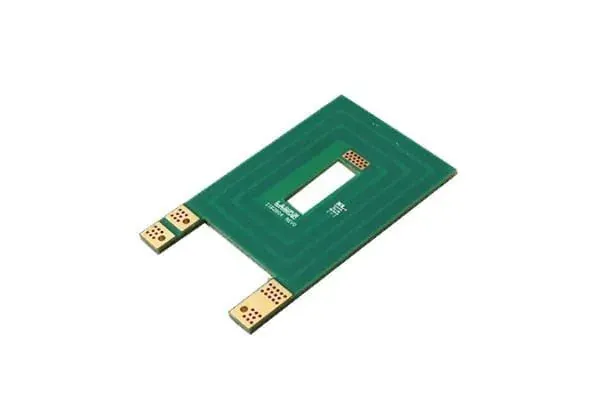
Look at the cover image on this page: a bare board with three tabs, each carrying a double row of gold contact pads. A fixture for that board is a mechanical negative of exactly those pads — probe positions, probe heights, hold-down geometry, the support pattern that keeps the board from flexing while forty-odd spring probes push up on it.
That geometry is not generic. It is specific to one revision of one board. Which gives a fixture three properties that no consumable has:
It persists across orders. A reel of resistors is consumed by the build. A fixture is not. It sits on a shelf between orders, and the next order depends on it still being there, still calibrated, still matching your current board revision.
It has a version. Move a tab, add a test point, change the panel step-and-repeat, and the fixture is either modified or rebuilt. There is no reflow-and-continue path. This is why "who pays for fixture changes" is a different question from "who paid for the fixture," and why answering only the second one leaves you exposed on every revision for the life of the product.
It is a precondition, not an input. Without components you cannot build. Without a fixture you can build and simply cannot prove the result. In practice that means a missing fixture does not stop a transfer — it stops the *qualification* of a transfer, which is worse, because the boards exist and the evidence does not.
Anything with those three properties needs an owner on paper. Components do not; we covered component and laminate ownership separately in material ownership in contract assembly, and the clause structure there is genuinely different — consigned material settles per lot, a fixture persists per revision.
Paying and owning are two separate switches
The single most common assumption is that the payer is the owner. In contract assembly these are independent, and there are four combinations, all of which occur in real agreements:
| Who pays | Who owns | What it means in practice |
|---|---|---|
| Buyer, as explicit NRE | Buyer | Cleanest. Fixture is your asset, held at the assembler's site under a bailment or custody clause. Transferable. |
| Buyer, as NRE | Assembler | You funded a tool you cannot move. Happens when the PO says "fixture NRE" and says nothing about title. |
| Amortised into unit price | Assembler | Default when nobody asks. There is no purchase event, so there is nothing to claim. |
| Amortised into unit price | Buyer after volume threshold | Workable hybrid, but only if the threshold and the title-transfer trigger are both written down. |
Row two is where most buyers actually sit, and they do not know it until they ask for the crate. An invoice proves you paid. It does not prove you bought. If the PO line reads only *test fixture NRE — [amount]*, you have paid for a service (the creation of a fixture) and acquired nothing enforceable.
So the first thing to fix is not the amount. It is making the PO say which of those four rows you are in.
The five things that must be written separately
One sentence saying "fixtures belong to the buyer" is not enough, because it answers one of five questions and leaves four to custom and goodwill. Each of these needs its own line:
1. Title. Who owns it, and from when. State the trigger explicitly: on payment of the NRE, on acceptance of first article, or on reaching [volume] units. Include what is covered — fixture base, top plate, probe set, wiring harness, and critically the test program and its source. A fixture without the program is a mechanical shell. If the program was written in the assembler's licensed test platform, say now whether you get the source, a runnable export, the documented test limits, or nothing. This is the most frequently omitted item and the most expensive one to discover late.
2. Custody and storage. The fixture lives at the assembler's site, so you need a bailment-style clause: they hold your property, they are responsible for it while held, it is identified as yours in their asset records, it is not used for other customers' work, and it is not disposed of or scrapped without written notice. Add environmental expectations if your fixture has probes or load cells that degrade in storage. Add what happens if the assembler is acquired, relocates or becomes insolvent — ownership on paper is exactly what makes your fixture separable from their estate.
3. Maintenance and calibration. Probes wear. Contacts oxidise. Pneumatics leak. Decide who performs periodic maintenance, who pays for consumable probe replacement, at what interval or trigger, and who holds the calibration record. Then decide what evidence you receive — a maintenance log on request, a calibration date reported with each lot, or nothing. If a test escape later traces to a worn probe, the maintenance clause is what determines whose problem that is. Tie this to your test requirement definition rather than leaving it floating; the scope of what the fixture must prove is set in test and inspection requirement definition.
4. Revision responsibility. Your board will change. For each change class, say who pays: a change you initiate (your cost, normally), a change required by an assembler process issue (theirs, arguably), a change forced by component obsolescence (negotiated). Also say what happens to the old fixture — retained, scrapped, or held for [period] to support field returns and warranty builds of the previous revision. Products in the field need testable spares long after the line has moved on, and fixtures get scrapped for shelf space without anyone intending harm.
5. Transfer and return. The clause you only use once, which is why it gets left out. Specify: notice period for a return request, who pays crating and freight, condition on return, what documentation accompanies it (program, wiring map, probe BOM, calibration record, known issues), and the deadline. Add that return is not contingent on commercial disputes being resolved — otherwise your fixture becomes collateral in a negotiation about something else entirely.
Write all five. Four out of five means the missing one becomes the leverage point.
Cost-split structures that actually hold up
There is no single correct split. There are structures with different risk profiles, and the right one depends on how confident you are about volume and how long the product will live.
Full buyer-funded NRE, buyer title. You pay the fixture cost up front as a separate PO line, title passes on payment. Highest cash outlay, lowest ambiguity. Appropriate when the product has a long life, when you expect to dual-source, or when the test program embodies IP you cannot afford to leave behind. This is the default recommendation for anything you intend to second-source.
Amortised with a title-transfer trigger. The fixture cost is spread across unit price over [quantity] units; once that quantity ships, title transfers to you automatically and the amortisation stops. Lower up-front cash, but two numbers must be written: the recovery quantity and what happens if you *never* reach it. Without the second, the assembler carries open-ended risk and will price defensively, or you will discover at unit [quantity minus one] that you own nothing.
Shared split on a shared base. Many assemblers hold a stock of standard fixture bases and press frames, and only the board-specific top plate, probe plate and wiring are unique to you. A clean structure: they own the reusable base, you own and can remove the board-specific assembly plus the program. Lower cost than buying a whole station, and honest about what is genuinely yours. Make sure the clause names the removable parts, or "fixture" will be read to mean the whole thing on the day you ask.
Assembler-owned, service-priced. The fixture never becomes yours; test is simply a service with a per-unit price. Legitimate and sometimes right — low volume, short product life, no second-source intention. Accept it only with eyes open: your exit cost is a full fixture rebuild, so budget it as a known future expense rather than a surprise.
Whichever you pick, keep the fixture on its own PO line with its own description. Fixture cost buried inside a blended unit price is unrecoverable, un-auditable, and the main reason row two of the table above is so common.
Revision and transfer: the two events that expose the clause
Everything above is theory until one of two things happens.
A revision. You move a test point. Now someone has to decide whether the existing fixture can be modified or must be rebuilt, who scopes that decision, who pays, how long it takes, and whether the previous revision stays testable. If your agreement says only "buyer owns fixtures," every one of those is a fresh negotiation under schedule pressure, and schedule pressure is where buyers concede. Pre-agreeing the change classes costs one paragraph and removes the negotiation entirely.
Note also that a fixture change is a test-system change, which means your first article evidence for the new revision is not comparable to the old unless the test limits were preserved. If the fixture is rebuilt, say whether the test program and limits carry over unchanged or are re-derived — a quietly re-derived limit is how two revisions end up with incomparable pass rates. The release conditions for that first article are their own subject, covered in first article inspection report and release terms.
A transfer. You are moving to a second assembler, or exiting. This is where the five clauses either work or do not. The practical sequence when they do work: issue the return request under the notice period, receive the fixture with its documentation package, have the receiving assembler inspect and verify it against your board, run a correlation study so you can show that the same boards pass on the same fixture in the new location, then release. When they do not work, you skip straight to "the new assembler will build a new fixture," add [lead time] to the transfer, and lose the ability to compare before-and-after test data at all.
The correlation point deserves emphasis because it is the hidden value of fixture portability. Moving the physical fixture is not primarily about saving its cost. It is about keeping the measurement constant while the factory changes, so that if yields differ you know the difference is the process and not the test. Rebuild the fixture and you change both variables at once. For the same reason, build definition and test system should be frozen together when you qualify an alternate source — the equivalence logic is the same one we apply to the board itself in second-source build equivalence.
Where it lands in the paperwork
Four documents, four different jobs:
- RFQ. Ask for fixture cost as a separate line, and ask three questions: what will the fixture consist of, what will you own on payment, and what is your return path. Suppliers who answer crisply have done this before. Request these in the quote, not after award — see what to include on the quote request.
- Quote comparison. Normalise before comparing. A quote with low NRE and high unit price may be amortising silently. Compare total cost over your expected volume *and* compare what you own at the end. Two quotes that cost the same can leave you in completely different positions.
- PO. The fixture line names the deliverable, the amount, the title trigger and a reference to the custody and return clauses. A PO that says only "test fixture NRE" is the failure mode, not a shortcut.
- Agreement or quality agreement. The five clauses live here, along with revision classes, maintenance responsibility, retention period for superseded fixtures, and insolvency handling. This is the document that still works when the relationship does not.
How this goes wrong
Patterns worth recognising, in rough order of frequency:
- Paying NRE and assuming title. The invoice is treated as a bill of sale. It is not.
- Buying a fixture without the program. You get the hardware and no runnable test. Specify the program, its limits and its source or export format in the same clause as the hardware.
- Letting fixture cost hide in unit price. Nothing was purchased, so nothing can be reclaimed, and you cannot even tell how much you have paid.
- Writing ownership but not custody. You own an asset sitting in someone else's building with no clause describing their duty of care, no identification as yours, and no protection if they are acquired or wound up.
- Silence on revisions. Ownership is settled, modification cost is not, and you renegotiate on every ECO under time pressure.
- Scrapping the superseded fixture. Shelf space wins, then a warranty build of the old revision arrives and cannot be tested.
- Agreeing by email. The assembler's project manager confirms you own the fixture. That person changes jobs. The contract does not mention it. Email is a record of intent, not a term.
- Discovering the question at exit. The single most expensive version of all of the above, because by then you have no leverage and a schedule commitment.
Before you release the PO
Check that you can answer each of these from a document, not from memory:
- Which of the four pay/own combinations are you in, and does the PO say so?
- Does the title trigger name a specific event or quantity?
- Does the covered scope include the test program, its limits, and a usable export?
- Is there a custody clause identifying the fixture as your property while held?
- Who maintains it, at what trigger, and what evidence do you receive?
- For each revision class, who pays, and how long is the superseded fixture retained?
- Is there a return path with notice period, freight responsibility and a documentation list?
- Is return independent of commercial disputes?
- If the fixture cost is amortised, are both the recovery quantity and the shortfall case written?
- Could you, today, state your total exit cost for test capability as a number?
If the last one has no answer, the fixture is still a cost in your records and an asset in someone else's. For the board-side and capability-side inputs that sit alongside this, see PCB assembly and capabilities.
FAQ
Does paying the test fixture NRE mean I own the fixture?
Not by itself. An invoice proves payment for the creation of a fixture; it does not transfer title unless the PO or agreement says title passes and when. Add an explicit trigger — on payment, on first article acceptance, or at [volume] units — and name what is covered, including the test program.
What exactly should the ownership clause cover besides the hardware?
The fixture base and board-specific plates, the probe set and wiring, the hold-down mechanism, and the test program with its test limits and a runnable export or source. Hardware without the program is a mechanical shell. If the program was authored on the assembler's licensed platform, settle in advance whether you receive source, an export, documented limits, or nothing.
Who pays when my board revision forces a fixture change?
Define it by change class rather than case by case. A buyer-initiated design change is normally the buyer's cost; a change caused by an assembler process issue is reasonably theirs; a change forced by component obsolescence is usually negotiated. Also state how long the superseded fixture is retained, since field returns of the previous revision still need a way to be tested.
Can I take the fixture with me when I change assemblers?
Only if you have title plus a written return path. The return clause needs a notice period, freight and crating responsibility, return condition, a documentation list, and independence from any open commercial dispute. Without that last point the fixture becomes leverage in an unrelated negotiation.
Is it better to pay the fixture cost up front or amortise it into unit price?
Up-front NRE with title on payment is cleaner and is the better default if the product has a long life or you intend to second-source. Amortisation lowers initial cash but needs two numbers written down: the recovery quantity that triggers title transfer, and what happens if you never reach it. Missing the second is how buyers end up having paid without owning.
The assembler says the fixture is built on their standard base. What can I actually own?
Usually the board-specific assembly — top plate, probe plate, wiring, and the program — while they keep the reusable base and press frame. That is a reasonable split, but the clause must name the removable parts. If it just says "fixture," the word will be read to include the base on the day you ask for it.
Why move the physical fixture instead of letting the new assembler build one?
To keep the measurement constant while the factory changes. If you rebuild the fixture during a transfer, you change the process and the test system at the same time, so a yield difference cannot be attributed to either. Transferring the original fixture lets you run a correlation study and show the same boards pass the same way in the new location.
What happens to my fixture if the assembler is acquired or becomes insolvent?
This is the main practical reason to hold title and have a custody clause. Property identified as yours in their asset records, under a bailment-style term, is separable from their estate. A fixture you merely funded, with no title language, is not — it is their asset, and you are a creditor.
---
Need PCBs for Your Project?
Get an instant quote — prototypes from $2, delivered worldwide.
Get Instant Quote