Turnkey PCBA BOM Risk Management and Alternate Part Approval Checklist
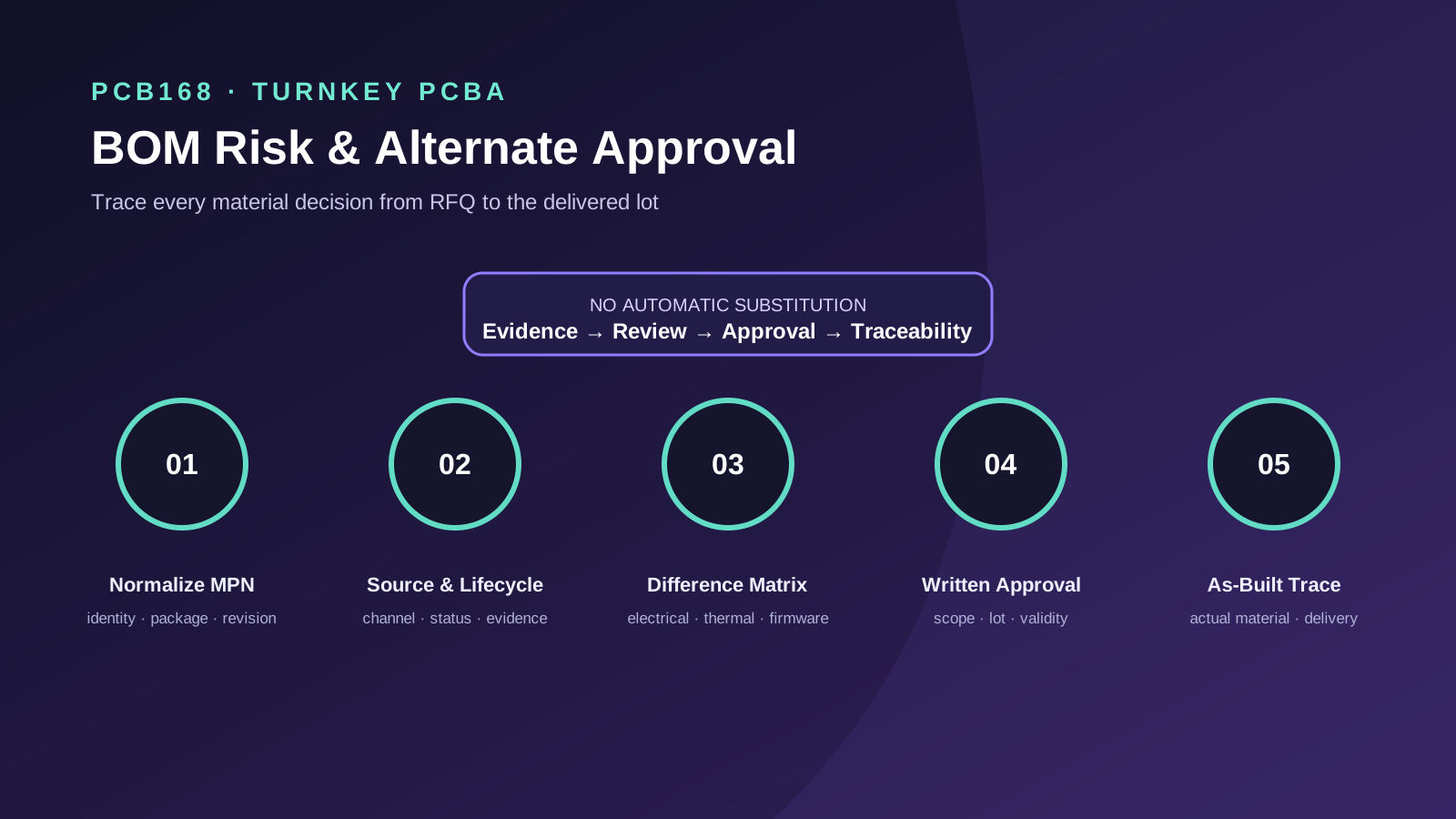
A turnkey PCBA quote is not simply the sum of a bare board, components and assembly operations. For purchasing, one ambiguous identity, constrained source, lifecycle change or unclear substitution rule can make the initial quotation impossible to execute. For engineering, “same package and same headline parameter” does not establish equivalence. Electrical limits, pin definitions, firmware dependencies, qualification status, thermal behavior, solderability and lifecycle may all differ.
BOM risk management should neither grant an assembler unrestricted authority to select cheaper alternatives nor freeze every line so tightly that procurement becomes impossible. A controlled approach creates one BOM baseline before quotation, identifies risk, defines sourcing and substitution authority, and links each proposal, approval, purchase and actual assembly lot. The PCB assembly process guide provides broader process context, while the PCB assembly product page is the relevant project entry point. This article makes no PCB168-owned claim about sourcing channels, inventory, equipment, certification, capacity, lead time or customer cases.
1. Make the BOM one machine-readable source of truth
A usable BOM should identify the internal part number, complete manufacturer name, complete manufacturer part number or MPN, quantity, reference designators, package or mechanical description, fit status, substitution status and controlled notes. Do not use a distributor page title in place of an MPN. Do not place several possible parts in one cell without priority and approval meaning. No-fit, optional and configuration-dependent lines need a status that both software and reviewers can interpret.
The BOM revision must correspond to the PCB data, schematic, placement coordinates, assembly drawing, stencil basis and program inputs. If an engineering change updates the BOM but not the associated assembly information, the material can be correct while the placement or orientation basis remains obsolete. Use a release index and remove superseded files from the active package. The PCBA solder joint failure guide covers downstream failure analysis; material identity and BOM consistency should be resolved before assembly rather than discovered after soldering.
2. Review identity, technical scope and lifecycle line by line
BOM normalization starts by checking that each complete MPN resolves to one manufacturer and a controlled datasheet. Similar suffixes can represent different packaging, temperature grades, terminal finishes, programmed states, declarations or shipping forms. They should not be dropped during data entry. Passive components also require the approved resistance or capacitance, tolerance, rating, temperature characteristic, case size and any required failure-mode attribute, rather than only three convenient fields.
Record lifecycle status, product change notifications, discontinuance information, pack quantity, moisture or storage controls, programming or calibration needs, and project restrictions on source or date code. Lifecycle status changes; an available web listing at RFQ time is not a long-term commitment. Capture the evidence source and review date, then reconfirm before the purchase is placed. Put uncertain items on the question list. “Probably compatible” is not a closure state.
3. Establish source rules, not only price comparisons
The turnkey plan should state how original manufacturers, authorized distributors, customer-nominated channels, customer-supplied material and other specifically approved sources are handled. Authorization must be checked against manufacturer or channel information available at the time of purchase; a professional-looking marketplace page is not proof. If the project permits a non-authorized source, define additional documentation, inspection, traceability and risk approval before purchasing.
The quotation should expose unit price, package quantity, minimum buy, non-cancellable or non-returnable terms, freight and tax assumptions, and ownership of excess material. Do not hide the cost of a required reel in an unexplained per-board amount, and do not assume excess material automatically belongs to either party. If market conditions limit quote validity, the current formal quotation should say so. This article intentionally gives no fixed price or lead-time range.
4. Use risk ranking to control review order
A risk method can help prioritize the BOM, but a score should not be presented as a precise prediction. High-attention items often include single-source or discontinued parts, parts approaching end of life, constrained supply, firmware-bound devices, safety or regulatory functions, critical connectors, custom magnetics, and items that require renewed verification after change. Medium attention may include packaging constraints, common parts with complex suffixes, or components with several candidates but no approved second source.
The risk register should capture MPN, reason, evidence date, possible impact, owner, action and closure state. Actions can include an earlier purchase, customer-supplied material, an approved second source, redesign, or retaining the original part while accepting schedule impact. Purchasing owns market evidence; engineering owns technical equivalence; quality owns source and traceability boundaries. No single function should silently complete all three decisions.
5. Compare the full function of an alternate part
An alternate comparison begins with identity: candidate manufacturer, full MPN, datasheet revision, lifecycle and proposed source. It then compares body and land compatibility, pin definition, absolute maximum and recommended operating conditions, critical performance, timing or interfaces, thermal characteristics, temperature range, moisture sensitivity, solderability or terminal finish, declarations and project-specific constraints. For microcontrollers, memories, sensors, communications and power devices, review firmware, boot configuration, calibration, registers, programming tools and test coverage.
A higher rating does not guarantee equivalent system behavior. A lower on-resistance, different input capacitance or different protection structure can change circuit operation. An identical package outline does not prove identical pinout, exposed-pad design or mounted height. Classify every difference as none, acceptable, verification required or unacceptable, and attach the original source or controlled copy. A blank field with no evidence cannot be assumed equal.
6. Put approval scope into formal change control
An alternate approval should identify the product, PCB and BOM revision, reference designators, original MPN, candidate MPN, applicable quantity or lots, validity period, verification required, approvers and withdrawal conditions. Approval for one prototype does not automatically become permanent production approval. Approval at one reference designator does not automatically cover every use of the same internal material number. If two MPNs may be purchased in parallel, define priority and source conditions in the project's AVL, AML or equivalent approved list.
Review may require design analysis, sample assembly, functional testing, environmental evaluation or reliability work. The product risk and customer requirements determine the scope; no generic article can prescribe it. After approval, update the BOM, purchasing list, incoming controls, assembly program inputs and tests. An email saying “alternate accepted” while the released BOM remains unchanged prevents later lots from identifying the actual approval state.
7. Maintain traceability through receiving, kitting and line release
Each received lot should link to the purchase order, source, manufacturer identity, complete MPN, quantity, lot or date information, and project-required shipment documents. If labels, packaging and physical markings disagree, segregate and resolve the discrepancy rather than relabeling from experience. Customer-supplied and assembler-purchased components should follow the same identity discipline while ownership and responsibility are recorded separately.
Kit material by BOM revision, reference designator and approved-alternate state. If one internal number can represent several approved MPNs, the system or issue record must retain which one was actually used. Record substitutions, replenishment and returns so excess stock does not silently enter another revision. First-article inspection and test should reference the as-built BOM state, not only the original quotation BOM.
8. Close BOM risk in the delivery package
Before turnkey delivery, reconcile the as-built BOM, approved alternates, shortage dispositions, rework or deviation records, test revision and excess-material status. Supply the material traceability, conformity records or change summary required by the contract. A component supplier datasheet is not certification of the finished assembly, and a power-on test should not be expanded into proof that every component parameter and long-term reliability condition has been validated.
When using the quotation page, provide the BOM, AVL or AML when applicable, alternate approval template, PCB and assembly package, and required test scope. If responsibility boundaries need clarification first, use the contact page. The final record should answer seven questions: What was planned? What was purchased? From where? Who approved each difference? In which lot was it assembled? What verification was completed? Who accepted the remaining risk? When those answers remain connected, turnkey moves from “buy and build” to a controlled delivery process.
FAQ
Can a turnkey PCBA BOM list only value and package? It should not. Supply the complete manufacturer and MPN where possible, and define an approval rule for lines that permit alternatives. Value and package alone leave source, suffix, lifecycle and compatibility ambiguity.
Can a part with the same package and main parameters be substituted automatically? No. Compare pinout, operating conditions, timing, thermal behavior, terminal finish, firmware, declarations and project verification needs, then obtain written approval from the defined roles.
Can a broker or marketplace source be used when authorized distribution has no stock? Follow the project's source rule. If another source is permitted, authenticity, traceability, inspection and risk approval requirements should be defined before purchase; price and a stock listing are not release evidence.
Can a prototype-approved alternate be used for all production lots? Not automatically. The approval must state product, revision, reference designator, quantity or lots, validity and verification scope.
Which BOM records should accompany turnkey delivery? The contract controls the answer. Common deliverables can include an as-built BOM, approved-alternate summary, required traceability or conformity records and unresolved deviations. Do not assume all internal purchasing records ship, and do not omit records that were agreed.
Sources
- IEC 62402, general obsolescence-management framework for lifecycle risk identification and planning; cited as guidance, not a PCB168 certification claim.
- IPC-2581, general electronic manufacturing-description data exchange framework, useful for relating BOM, design and manufacturing information; the project controls the approved format.
- J-STD-001, process and requirement framework for soldered electronic assemblies; revision, class and contractual use are project-specific.
- IPC-A-610, electronic assembly acceptability reference; it does not establish component authenticity, technical equivalence or product functional validation.
- Original manufacturer controlled datasheets, product change notices, end-of-life or discontinuance notices, authorized-channel information, and the customer-approved BOM, AVL/AML, schematic, assembly drawing, firmware and test specification.
Need PCBs for Your Project?
Get an instant quote — prototypes from $2, delivered worldwide.
Get Instant Quote