HDI PCB Prototype Service Scope: What Production Equivalence Did You Buy?
1. The price gap between prototype quotes is rarely about the board
Put three HDI prototype quotes side by side against one data pack and the spread is usually wider than
the boards could possibly justify. The instinct is to explain it with margin, with overhead, with how
badly each shop wants the account. Occasionally that is the answer. More often the quotes are not
describing the same service.
The same files can be built along more than one process route. Several of those routes will produce
boards that look identical on arrival, pass electrical test, and light up in the lab. What separates
them is not the artifact. It is whether the run that produced it tells you anything reliable about the
run that comes next.
That property has a name buyers rarely use at quoting time: equivalence to production. A prototype
either was built in a way that predicts volume behaviour, or it was built in whatever way got a working
board out the door soonest and cheapest. Both are legitimate services. They answer different questions,
and they are not interchangeable — which is exactly why they are priced differently.
The failure mode is not that cheap prototypes exist. It is that the quote does not say which one you
are holding. A unit price and a lead time are both visible. The route behind them is not, and nothing
on the paperwork obliges anyone to describe it. So the comparison happens on the two numbers that are
printed, and the variable that actually matters stays off the page until the first production lot.
2. Equivalence is not one property. It is a set of conditions that can be dropped separately
The reason "is this prototype representative?" gets vague answers is that it is the wrong shape of
question. Representativeness is not a switch. It is a bundle of conditions, each of which can be
included or excluded on its own, and each of which fails in its own way later.
Industry practice generally treats these as five separate groups:
Route equivalence. Was the board built through the same sequence of operations, on the same class
of equipment, as the production article would be? An HDI structure can often be reached by more than
one build sequence. A route chosen for sample speed can produce an acceptable one-off while behaving
quite differently once it has to repeat.
Material and construction equivalence. Was the same material designation and the same construction
used, from the same qualified source? Substituting what is on the shelf is a normal and sometimes
sensible prototype decision. It is only a problem when nobody records that it happened.
Panel and tooling equivalence. Was the board built in the panel format and with the tooling that
production would use? Sample panels are frequently assembled for convenience, which changes how the
part sits relative to everything that references the panel.
Inspection and test equivalence. Was the sample examined against the same criteria, with the same
coverage, that production lots will face? A board that passed a reduced check has not been measured
against the standard its successors must meet.
Documentation and configuration equivalence. Is it recorded which revision was built, by which
route, with which substitutions, and under whose approval? Without this group, the other four cannot
be audited after the fact — only asserted.
Two things follow. First, "equivalent" with nothing attached is not an answer; the useful answer names
which groups are in and which are out. Second, a supplier excluding a group is not behaving badly.
Excluding groups is how a prototype gets cheap and fast, and that is frequently the right purchase.
The defect is silence, not exclusion.
3. Where each exclusion surfaces during transfer
Exclusions are cheap at the prototype stage because their cost is deferred, not removed. Each group has
a characteristic step at which its absence becomes visible, and a characteristic argument that follows.
Route exclusion surfaces at first production lot yield. The sample worked. The lot does not hold
together consistently. Nothing in the data pack changed, so the conversation turns to whether the files
were ever buildable at volume — a question the prototype was supposed to have answered and, under this
exclusion, never addressed.
Material or construction exclusion surfaces at qualification or at environmental testing. The
board that passed your bench evaluation was not made of what the production board is made of. Any
result that depends on material behaviour has to be re-earned, and the schedule that assumed the
prototype counted as evidence loses its foundation.
Panel or tooling exclusion surfaces at assembly. Registration-dependent and panel-referenced
behaviour changes when the panel changes. Boards that placed cleanly as a hand-fed sample can present
new problems once they arrive in the production array, and the assembler reports a board problem while
the fabricator reports that nothing about the board changed. Both are telling the truth.
Inspection or test exclusion surfaces at incoming acceptance. The first lot gets measured against
the full criteria for the first time. Findings appear that the sample would have shown, had it been
examined the same way. The dispute is then about whether this is new nonconformance or pre-existing
condition that was simply never looked for — and with no comparable sample record, that dispute has no
factual resolution.
Documentation exclusion surfaces everywhere, as the inability to close any of the above. This is
the group that converts a technical problem into a commercial one. When no one can establish what was
built or how, each of the other four failures becomes an argument about memory. Of the five groups,
this is the one worth insisting on even in the cheapest prototype purchase, because it costs the least
to include and is the only one whose absence makes the others unprovable.
Notice the pattern: the exclusion is invisible exactly until the point where it is expensive, and the
information needed to assign responsibility is the thing the exclusion removed.
4. What a prototype quote structurally cannot tell you
Compare two quotes built from identical files. Both state a unit price, a quantity, a lead time,
possibly a layer count and a material family. Neither is lying. And neither contains a field for any
of the five groups, because no standard quote format has one.
This is not an oversight by the supplier. A quote responds to a request. If the request asked for a
working board against these files, a working board against those files is what gets priced, and the
cheapest compliant route is the commercially correct one to offer. A supplier who volunteers route and
panel equivalence that nobody asked for simply quotes higher and loses the comparison to someone who
did not. The structure of an unqualified RFQ actively selects for the least representative build.
So the exclusions that matter tend to be invisible in these specific ways:
- A reduced inspection scope reads as nothing at all, because inspection rarely appears as a line item.
- A material substitution reads as the same material family, because the designation is often reported
at family level rather than as the specific product and source.
- A convenience panel reads as nothing, because panel format is usually treated as the fabricator's
internal business.
- A sample-expedient route reads as a shorter lead time, which looks like a benefit.
- Missing configuration records read as nothing, because no one asks for records of a thing that worked.
Every one of those presents either as a lower number or as blank space. None presents as a warning.
A buyer doing diligent comparison on the visible fields will systematically choose the least
representative option and have no indication that a choice was made.
The remedy is not to distrust the quotes. It is to change the request so that the fields you care about
have somewhere to appear.
5. The scope questions that make the exclusions visible
Each question below targets one group and is phrased so that a non-answer is as informative as an
answer. None of them asks the supplier to commit to a capability, which matters: capability questions
invite optimism, while scope questions invite a boundary. You are trying to learn where the edge of the
service is, not how good the shop is.
On route. "Will this prototype be built through the same process sequence and equipment class you
would use for production of this part? If any step differs for the sample, which step, and why?"
A supplier who answers this plainly has told you most of what you need. One who answers "we build
everything in house" has answered a different question — in-house is about who performs the step, not
about whether the sample's sequence matches production's.
On material and construction. "Will the specific material product and construction be the ones
production would use, from the same source? If a substitution is used for availability, will it be
identified in the paperwork that ships with the boards?" The second half is the part to insist on.
Substitution is routine; unrecorded substitution is what destroys the evidentiary value of your
own test results.
On panel and tooling. "Will the sample be built in the production panel format with production
tooling, or in a sample format? If sample format, which panel-referenced characteristics should we
treat as not yet demonstrated?" This phrasing is deliberate: it grants that a sample panel is
acceptable and asks only that the untested area be named.
On inspection and test. "Which inspection and test coverage applies to this prototype, and how does
it differ from the coverage a production lot would receive? Will we receive the records?" If prototype
coverage is reduced — often entirely reasonable — you want it stated, so that a finding on the first
production lot is understood as newly examined rather than newly occurring.
On documentation. "What revision, route, substitution and approval record ships with these boards?"
This is the cheapest question on the list and the one that preserves your ability to resolve everything
else. Ask it even when you are deliberately buying a non-equivalent sample.
One closing question that reframes all five. "If we approve this sample and place a production
order against the same files, which characteristics would you consider still unqualified?" A supplier
willing to answer this is a supplier you can transfer with. One who treats the question as distrust has
told you something useful about how the first yield conversation will go.
Send these with the files, not after the quotes arrive. Asked up front, they change what gets priced.
Asked afterwards, they only change what you know about a price that was already set against a different
assumption.
6. When buying a deliberately non-equivalent prototype is the right call
None of this argues for always buying the most representative sample. Full equivalence costs real money
and real schedule, and plenty of prototype runs have no business paying for it.
Buying non-equivalent is the correct decision when:
- The question is functional, not manufacturing. You want to know whether the circuit works, the
firmware runs, the mechanical fit is right. Route and panel equivalence contribute nothing to that
answer, and paying for them delays the answer you actually need.
- The design is still moving. Qualifying a route against a revision you are about to change throws
the qualification away with the revision. Early iterations should be cheap and fast on purpose.
- Volume is genuinely uncertain. If the product may never reach production, production
representativeness is an option you are unlikely to exercise.
- You are checking whether the files are complete at all. A fast sample is an efficient way to find
out whether the data pack produces anything, before investing in a qualified build.
The rule is not "buy equivalence." It is buy it deliberately, and know which groups you declined.
A cheap sample bought knowingly, with its exclusions written down, is a sound purchase. The same sample
bought in the belief that it qualified the part is how a transfer schedule breaks — and the two are
indistinguishable from the board itself.
This also means equivalence does not have to be bought all at once. The groups are separable, so they
can be staged: functional iterations with documentation only, then a later run that adds route, panel
and inspection equivalence once the design has stopped moving. What should never be staged is the
documentation group, because it is what lets the earlier runs still mean something later.
7. A minimum scope statement to attach to the RFQ
Short, neutral, and written so a supplier can answer it without negotiating:
> For this prototype, please state for each item whether it is inside the quoted scope:
> (1) production process sequence and equipment class; (2) specific material product, construction and
> source; (3) production panel format and tooling; (4) production inspection and test coverage, with
> records; (5) revision, route, substitution and approval record shipped with the boards.
> Where an item is outside scope, name the characteristics we should treat as not yet demonstrated.
> We are not requiring full equivalence — we are recording what this run does and does not establish.
The last sentence does most of the work. It tells the supplier that a cheap, fast, clearly-bounded
offer is acceptable, which removes the incentive to quietly include less than you asked for. What you
get back is comparable quotes: not necessarily equal in equivalence, but equal in disclosure, which is
the only basis on which the price difference becomes interpretable.
8. Related reading on PCB168
- HDI PCB capabilities and structures — the structure vocabulary this article
assumes.
— the cost-line view: which prototype charges repeat per run and which do not.
— the same equivalence logic applied across two suppliers rather than across two runs at one.
assembly-side counterpart to scope disclosure.
- Request a quote — send the scope statement together with your files.
- Manufacturing capabilities overview.
9. FAQ
Is a cheap HDI prototype service a bad choice?
No. A low price usually reflects a narrower scope, and a narrow scope is often exactly right —
particularly for functional iterations on a design that is still changing. The problem is buying a
narrow scope while believing you bought a wide one. Price is only a warning sign when the exclusions
behind it are undeclared.
Doesn't "same files, same supplier" already guarantee the production board matches the sample?
Not by itself. Identical files can be realised through more than one route, panel format and inspection
coverage. Same supplier removes some variables and leaves the rest open, which is why equivalence needs
to be stated for the run rather than inferred from the file set and the vendor name.
If the prototype passed electrical test, what is still unproven?
Electrical test confirms the board you hold behaves as intended. It says nothing about whether that
outcome repeats across a lot, whether the material matches what production will use, how the part
behaves in the production panel, or how it reads against full inspection criteria. Those are separate
questions and they fail separately.
Who is responsible when the first production lot behaves differently from an approved sample?
It depends on what the approval covered — which is why the documentation group matters more than it
appears to. If the sample's route, material, panel and inspection coverage were recorded, the two runs
can be compared and the difference located. Without those records, the discussion has no facts to work
from and tends to be settled by whoever has more commercial leverage.
Should I ask for full equivalence on the first prototype?
Usually not. Early runs exist to answer design questions, and qualifying a route against a revision
you are about to change wastes the qualification. A common sequence is: cheap functional iterations
with documentation only, then one run that adds route, panel and inspection equivalence once the design
is frozen. Just make sure the staged plan is explicit, so the final pre-production run is not skipped
because earlier samples "already worked."
Will suppliers actually answer scope questions like these?
Many will, and the response itself is diagnostic. A clear answer naming what is excluded is a good
sign. A deflection toward general capability claims — in-house equipment, years in business,
certifications — is an answer to a question you did not ask, and worth noting before the first
yield discussion.
10. Image
- cover:
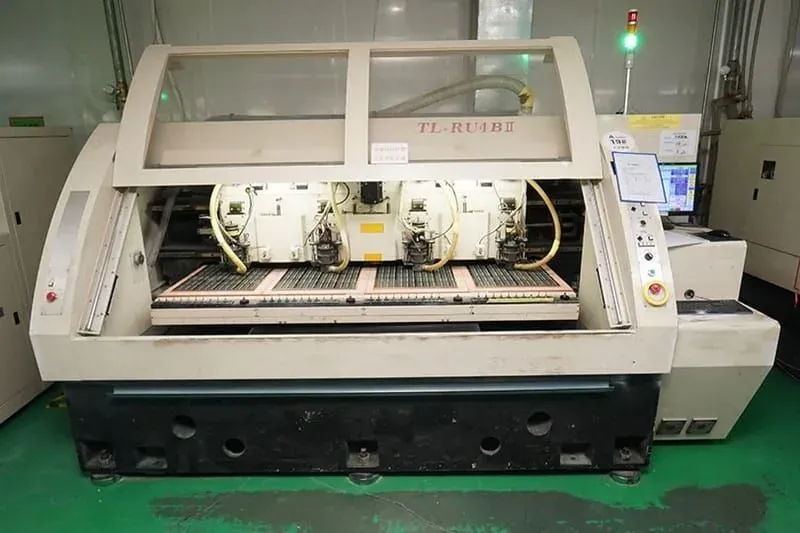
/images/products/ax51.webp - alt (en): Front view of an enclosed CNC machine with four spindle heads visible behind the
window, thin panels resting on the grid table below, a control panel with buttons and a red emergency
stop at the right, a paper work order tag hanging beside the display, and a green indicator lamp lit
above.
- concept: Two runs can pass through visually identical machines under different programs. The work
order hanging on the panel is what decides whether this run is rehearsing production. Equivalence is
declared, not observed.
---
Need PCBs for Your Project?
Get an instant quote — prototypes from $2, delivered worldwide.
Get Instant Quote