Heavy Copper PCB Assembly: Who Owns the Reflow Profile?
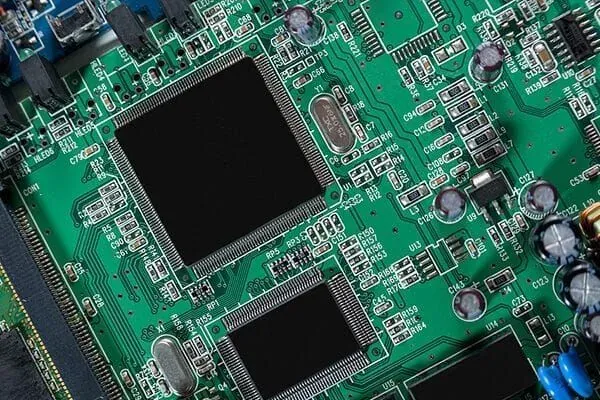
The board is a heat sink. The parts on it are not.
A heavy copper board behaves in reflow the way no normal board does, and the reason is mundane: copper stores heat.
Thick inner and outer copper layers, large planes and copper pours give the board a thermal mass that is large relative to everything sitting on it. Push that assembly into an oven and two things happen at once. The small parts — passives, fine-pitch leads, thin plastic bodies — follow the oven air closely, because they have almost nothing to absorb. The copper does not. It lags on the way up, it lags on the way down, and the pads tied directly into a heavy plane lag worst of all.
So your window closes from both sides at the same time. Give the oven enough energy and time for the heavy copper regions to reach a temperature where solder actually wets, and the low-mass parts have been sitting above their own limits for a while. Keep the small parts comfortable, and some joints over the heavy planes never wet properly. There is no setting that makes this disappear. There is only a profile that trades the two off deliberately, and that profile has to be *written by someone who knows both the copper distribution and the part limits*.
That last sentence is where contracts fail. The copper distribution is yours. The part limits come from the component datasheets. The oven is the assembler's. Nobody owns the intersection.
Why this lands as a dispute and not a defect
Walk through what normally happens after the first bad build.
Joints over the big planes come back dull, grainy, or visibly unwetted. Some tall parts are tombstoned next to a heavy pour. A connector body shows faint deformation. The buyer's reading: the assembler ran a generic profile and did not adapt it. The assembler's reading: the buyer supplied a board whose copper design falls outside the normal process window and never said so.
Both readings are defensible, which is exactly the problem. Look for the document that settles it and you will usually find:
- The RFQ said "SMT assembly per IPC-A-610 Class 2."
- The PO said nothing about profiling.
- The quotation priced "machine setup" as a line item without defining what setup produced.
- No profile record was requested, so none was retained — or one exists in the assembler's internal system that you have no right to see.
Nothing in that set assigns the profile. Class 2 tells you how the finished joint will be *judged*. It does not say who was responsible for the parameters that created the joint. Acceptance class and process ownership are two different clauses, and buyers routinely write the first and skip the second. If you want to see how far the acceptance side can be pushed on its own, that is covered separately in solder joint acceptance class and defect disposition — but no acceptance clause will retroactively tell you who was supposed to write the profile.
This article closes that gap with four declarations. They are short enough to paste into an RFQ and specific enough to be priced.
Declaration 1 — Who develops the profile, and on what
Write down which party develops the reflow profile, and on what physical article.
There are only three honest answers, and they cost different amounts:
(a) The assembler develops it, on your boards. The normal arrangement. Say it explicitly anyway, because "the assembler decides the parameters" and "the assembler is responsible for the parameters being appropriate to this board" are not the same commitment, and only the second one helps you later.
(b) The assembler develops it, on a dedicated profiling article you pay for. This is the one heavy copper actually calls for. Profiling means attaching thermocouples at chosen locations and running the board through to record what those locations really saw. On a heavy copper assembly the whole point is to measure the *difference* between a low-mass part and a joint buried in copper — which means the instrumented board is consumed. It cannot ship. Somebody is paying for that board and those parts, and if the PO does not say who, the assembler will either skip profiling or absorb it by guessing.
(c) You supply the profile. Legitimate when you have a qualified process from a previous build and want it reproduced. It also transfers the risk to you completely. If you hand over parameters, the assembler is responsible for *executing them as given*, not for the result being good. Be certain that is what you want.
Then state what the development is based on. Not a target number — you do not need to specify temperatures to write a good clause — but the *inputs*:
- the stackup and copper weight distribution, including which pads tie into heavy planes
- the component list with the thermally limiting parts flagged
- the solder alloy and paste
- the board outline, thickness and any carrier or fixture requirement
That list is the real content of this declaration. A profile developed without the copper distribution in hand is a profile developed for a generic board.
Clause language:
> Supplier shall develop the reflow profile for this assembly, taking into account the copper weight distribution and plane connectivity disclosed in the fabrication data and the thermal limits of the components identified in the BOM. Profile development shall be performed on an instrumented sample article; quantity, consumption and cost of that article shall be stated in the quotation.
Declaration 2 — Which inputs you are obliged to supply
A profile is only as good as what the assembler was told. Half the disputes in this category trace back to an input the buyer had and never sent.
Copper weight per layer, and where the copper is. Copper weight on a stackup drawing tells the assembler the total mass. It does not tell them where it is concentrated or which pads are thermally bonded into it. A pad hanging off a thin trace and a pad dropped straight into a thick plane behave like different components. If your data package only gives layer weights, the assembler is reading thermal behaviour off the Gerbers by eye. Flag the regions.
Which parts are the thermal limit. Somewhere on your BOM there is a part that constrains the whole profile — an electrolytic, a plastic connector, a module, a part with a tighter classification than the rest. The assembler can look up every datasheet, but they will do it faster and more reliably if you have already said which part sets the ceiling. State it by reference to the manufacturer's datasheet and its declared classification reflow condition. Do not restate numbers in the RFQ; let the datasheet be the authority.
Moisture sensitivity status. MSL handling is a separate clause but it is a profile input, because a part that absorbed moisture fails during reflow regardless of how good the profile is. If bake and floor-life terms are not already in the PO, put them there — see moisture sensitive device handling as a PO declaration. What matters here is the sequence: handling terms first, then profile development, because a profile developed on improperly conditioned parts proves nothing.
Double-sided and sequential build intent. If the board gets two reflow passes, the heavy copper regions get heated twice and parts from the first pass get a second exposure. Say upfront whether both sides reflow, or whether one side is selective or hand-attached. This changes the profile fundamentally and it is often buried in the assembly drawing rather than stated.
Thickness and warpage expectation. Heavy copper boards are frequently thick, and thick boards need more energy to get the inner regions moving. Thickness is in your data; whether the board needs a carrier or support fixture may not be. Ask.
Clause language:
> Buyer shall disclose copper weight per layer, the location of heavy copper areas and which component lands are thermally connected to internal or external planes. Buyer shall identify the components that constrain the reflow profile by reference to the manufacturer datasheet and its declared classification reflow condition. Buyer shall state the intended number of reflow passes per side.
Declaration 3 — Is the profile a deliverable?
This is the clause almost nobody writes and the one that decides every later argument.
The question is simple: when you receive the boards, do you also receive a record of what the oven actually did? Three possible answers:
No record. The default. The assembler holds the profile internally as process know-how. Perfectly normal in the industry and entirely sufficient for simple boards. On heavy copper it means that if joints fail, you have no evidence about the process and neither do they, in any form you can read. You are negotiating from memory.
Record exists, retained by supplier, available on request. The practical middle. The profile record is generated, archived against the job, and you have a contractual right to see it if there is a quality event. Cheap to agree to because it demands no new work, only a retention commitment and a disclosure right. Note that "available on request" needs a retention period attached or it decays to nothing.
Record is a delivered document. The profile record ships with the first article or with the lot. This is appropriate when you intend to transfer the build to another assembler later, when you need it for your own qualification file, or when the end application makes process records part of your obligation downstream.
If you want the record, say what it contains, in structural terms rather than numeric ones:
- which locations on the board were instrumented, and why those
- that the locations include at least one low-mass part and at least one land tied into heavy copper
- the measured trace for each location through the full pass
- the paste and alloy used
- the oven configuration identity under which it was produced
- date, job and board revision
The second bullet is the heavy-copper-specific one. A profile record from a single thermocouple on an easy location proves nothing about this class of board. The whole value is in showing both extremes of the thermal range on one board in one pass.
If first article inspection is already part of your flow, the natural home for this is the FAI package — the terms for which are covered in first article inspection report and release terms. Adding "reflow profile record" to an FAI deliverables list is far easier than negotiating it as a standalone document.
Clause language:
> The reflow profile record shall be generated and retained by Supplier for the period stated in the quality agreement and shall be made available to Buyer on request following any solder-related quality event. Instrumented locations shall include at least one low-thermal-mass component and at least one land connected to a heavy copper plane. [Where applicable: the record shall be delivered as part of the first article package.]
Declaration 4 — When the profile changes, who has to be told?
A qualified profile is a snapshot of one combination: this board revision, this BOM, this paste, this oven, this carrier. Change any element and the snapshot may no longer hold. On a normal board the margin absorbs most changes. On heavy copper the margin is what you spent the profiling exercise buying, so changes consume it directly.
Things that change without anyone treating it as a change:
- The oven. Equipment is reassigned between lines. A profile developed on one configuration is not automatically valid on another.
- The paste. Alloy substitution or even a different paste from the same alloy family alters process behaviour.
- The carrier or fixture. A support fixture is part of the thermal path. Running without it, or with a different one, is a different thermal system.
- Your copper. You added a plane, thickened a layer, or moved a connector onto a pour. From your side it is a minor layout revision. From the oven's side it is a new board.
- The BOM. An approved alternate part may have a different thermal classification than the part the profile was built around. This is the quiet one, because alternates get approved on electrical and mechanical equivalence and the thermal limit is rarely checked.
That last item is worth a sentence of its own: thermal equivalence is not part of standard alternate-part approval. If your approval process checks footprint, function and availability, it is not checking whether the substitute is compatible with the profile this board needs. Add it.
So the clause has to run both ways. Supplier notifies you of process-side changes; you notify supplier of board-side and BOM-side changes. For repeat orders, the cleanest place to anchor this is your existing change control terms — the structure is laid out in repeat order change control terms for heavy copper PCB — and the profile is simply one more controlled item inside it.
Clause language:
> Supplier shall notify Buyer in advance of any change to reflow equipment configuration, solder paste or alloy, or support fixturing that affects the qualified profile for this assembly, and shall state whether re-profiling is required. Buyer shall notify Supplier of any change to copper weight, plane connectivity, board thickness or thermally limiting components, including approved alternate parts. Either party's change may require a new profiling article at a cost agreed before the affected build.
Where this sits in the quote, and what it costs
None of this is free, and pretending otherwise is why it gets dropped. Put the cost where it belongs:
| Item | What it is | Where it appears |
|---|---|---|
| Profiling article | Board plus parts consumed to instrument and measure | NRE, per revision |
| Profile development | Engineering time to converge on a profile the board can tolerate | NRE, per revision |
| Profile record | Document generation and retention | NRE or quality agreement |
| Re-profiling | Triggered by change under Declaration 4 | Change order |
This is a one-off per revision, not a per-unit cost, which makes it an easy thing to approve and a bad thing to skip. If the quotations you are comparing do not show these lines, the suppliers either folded them into setup or assumed they are not needed — and you cannot tell which from the price. The broader habit of forcing scope into comparable lines is covered in PCB assembly contract manufacturing supplier scope.
One more framing point. The profile is the manufacturing-time thermal problem, not the in-service one. Choosing copper weight for current and operating temperature is a design decision made long before assembly, and it is a separate exercise — see current and thermal budget versus copper weight. The two interact in one direction only: the copper weight you chose for in-service reasons sets the difficulty of the profile someone will have to write. Nobody usually tells the assembler that choice was made for thermal reasons, which is why Declaration 2 asks you to.
Supplier replies and what to ask next
"We have extensive heavy copper assembly experience."
Ask: do you profile per board revision or per board family, and is the profiling article quoted separately? Experience is not a process commitment.
"Our profile is proprietary."
Reasonable. Then ask for retention and a disclosure right on quality events, not for the profile itself. Most suppliers will agree to the second even when they refuse the first.
"Profiling is included in setup."
Ask what gets consumed. If the answer is "nothing," no instrumented board was run and "profiling" means selecting a stored recipe.
"Send us the boards and we'll see how it runs."
Ask whether the first production lot is being used as the profiling article, and who owns the yield loss on it if so.
"We can run your existing profile."
Only useful if the oven, paste and fixture are the same, and they will not be. Ask whether they intend to verify the transferred profile on an instrumented board before running the lot.
Pasting it into your RFQ
Four lines, in order:
- Ownership. Supplier develops the reflow profile for this assembly based on disclosed copper distribution and component thermal limits. Profiling article quoted separately.
- Inputs. Buyer discloses copper weight per layer, heavy copper locations, plane-connected lands, thermally limiting components by datasheet reference, and reflow pass count per side.
- Deliverable. Profile record generated and retained; instrumented locations include one low-mass part and one plane-connected land; available on request after any solder-related quality event.
- Change control. Both parties notify changes to equipment, paste, fixture, copper, thickness or thermally limiting parts, including approved alternates. Re-profiling cost agreed before the affected build.
Acceptance class stays where it is — reference IPC-A-610 and your class as usual. These four lines sit upstream of it and answer a different question: not how the joint will be judged, but who was responsible for the conditions that made it.
For the fabrication side of a heavy copper order, start at the heavy copper PCB page; for assembly scope, the PCB assembly page; to put a package in front of engineering, use the quote form. Capability boundaries are whatever the PCB168 capability pages state publicly, confirmed per project in engineering review.
FAQ
Is a reflow profile normally included in PCBA quotes?
Profile development is usually assumed and rarely itemised. On heavy copper that assumption is the risk: the assembler may run a stored recipe and call it profiling. Ask whether an instrumented article is consumed, and whether it is quoted.
Who is at fault if heavy copper boards come back with unwetted joints?
Contractually, whoever the PO assigned the profile to. If the PO is silent, there is no fault-finding mechanism, only negotiation — which is the situation these four declarations exist to prevent.
Can I just specify the profile myself and avoid the question?
You can, and it moves the risk to you. The assembler becomes responsible for executing your parameters, not for the outcome. Reasonable when you have a qualified process you want reproduced; risky when you are guessing from a previous, different board.
Does an approved alternate part need profile re-verification?
If the substitute's declared classification reflow condition differs from the original's, yes. Standard alternate approval checks function and footprint, not thermal compatibility. Add thermal classification to your approval criteria.
Does a second reflow pass need a second profile?
The two passes are different thermal events — the second one heats parts already soldered and copper already cycled. Whether one profile covers both is a process decision for the assembler, but they can only make it if you declared the pass count. Declare it.
Does IPC-A-610 Class 2 or 3 settle profile ownership?
No. Acceptance class governs how finished joints are evaluated. Ownership of the process parameters is a separate clause and has to be written separately.
What should a useful profile record contain?
Which locations were instrumented and why, measured traces for each through the full pass, paste and alloy identity, oven configuration identity, and date plus board revision. For heavy copper, the locations must span both thermal extremes on the same board in the same pass, or the record does not describe the problem it was meant to describe.
Sources
- IPC-A-610, Acceptability of Electronic Assemblies — referenced by name for joint acceptance classes; no numeric criteria reproduced here.
- J-STD-001, Requirements for Soldered Electrical and Electronic Assemblies — referenced by name for process requirement structure.
- J-STD-020, Moisture/Reflow Sensitivity Classification for Nonhermetic Surface Mount Devices — referenced by name as the basis for component classification reflow conditions; buyers should read limits from the component manufacturer's datasheet, not from this article.
- IPC-7711/7721, Rework, Modification and Repair of Electronic Assemblies — referenced by name in the context of post-reflow intervention.
- Component manufacturer datasheets — the governing authority for any individual part's thermal limits and classification reflow condition.
- PCB168 capability pages — the only source used for what PCB168 offers; no capability figures, lead times, yields, equipment or customer cases are asserted in this article.
---
Need PCBs for Your Project?
Get an instant quote — prototypes from $2, delivered worldwide.
Get Instant Quote