PCB Shielding Cans: Splitting Supply and Assembly Responsibility in the RFQ
1. A shielding can is a three-party interface, not a line item
Treat the can as three deliverables that happen to touch:
- The board side — a ground pad ring or solder frame footprint, a keep-out for the can
wall, tooling or alignment features, and a declared component-height budget inside the
enclosed area. This is PCB data. It ships as Gerber and drawing.
- The hardware side — the can itself, or a frame plus a removable lid. This is a
purchased metal part with its own drawing, material, plating, and tolerance. It does not
exist in your Gerber files.
- The assembly side — how the can is attached (reflow with the rest of the SMT run,
a second pass, or hand soldering), in what order relative to the parts underneath, and
what happens to it during inspection and rework.
Each of the three can be quoted by a different party or all by one. The RFQ has to say
which. PCB168's PCB assembly page states the boundary
plainly: quotation input is BOM + fabrication + placement data, assembly scope is
confirmed by engineering review, and component supply is defined in RFQ. A can with
no supply model declared is exactly the ambiguity that "defined in RFQ" is pointing at.
2. Supply model: name it before you name a price target
Three models cover almost every enquiry. Pick one per part number, in writing.
Turnkey. The assembler sources the can. You must then supply enough to purchase it:
a drawing or a manufacturer part number, material and plating, whether it is one-piece or
frame-plus-lid, and whether an equivalent is acceptable. "EMI shield, 20×15 mm" is not a
purchasable specification. Without an approved-equivalent statement, any substitution
becomes a change that has to be re-approved.
Consigned (customer-supplied). You ship the cans. Declare quantity including attrition
allowance, packaging format (tray, bag, reel), and who owns the shortfall if some are
damaged or consumed during process setup. Consigned metal parts are also the most common
source of a stalled line, because they arrive late or in the wrong orientation for the
feeder.
Partially consigned. You supply the frames, the assembler buys the lids, or the reverse.
This is the model that most often produces a gap, because both sides assume the other
covers the interface piece. If you use it, list every sub-part and its owner on one row each.
For all three, the assembly page is explicit that **schedule and quantity are confirmed in
the quotation**, and that lead time, MOQ, equipment or test availability, certifications,
capacity, and traceability deliverables are confirmed **only in the written quotation or a
subsequent engineering response**. So do not treat a supply model as also settling delivery;
declaring the model is what makes the delivery answer possible.
3. Board-side inputs you must declare (and who authors them)
These are yours to author, because they live in the design database. The fabricator builds
what your files say; the assembler can only report a conflict after the fact.
- Ground pad ring or frame footprint. Continuous pad, segmented pads, or a frame
footprint. Segment length and gap are a design decision derived from your target frequency
— that derivation belongs in the design guides linked above, not in the RFQ. What the RFQ
needs is the finished footprint in the Gerber, with solder mask openings resolved.
- Alignment and keep-out. State the can wall keep-out and any tooling or datum features
the can placement depends on. If the can is placed by machine, the machine needs a
reference that exists on the board, not on the drawing only.
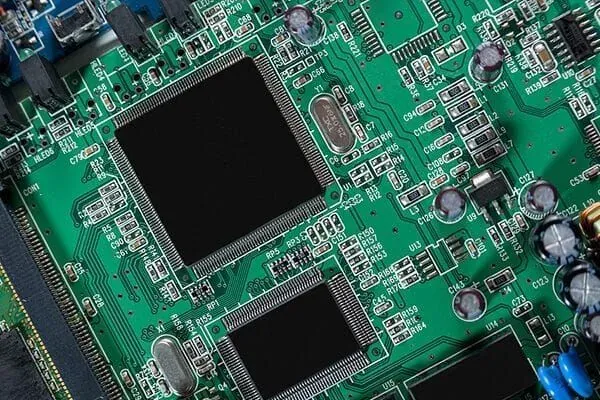
- Interior height budget. This is the input buyers forget most often. The tallest part
inside the enclosed area sets the minimum internal clearance of the can. On the board
shown on this page's cover image, the two large black square ICs and the small metal-lidded
oscillator beside them stand well above the surrounding 0402/0603 passives — if a can went
over that group, those parts, not the passives, would fix the required internal height.
Declare the tallest enclosed component with its designator, and declare whether any part
is allowed to contact the can interior. If nothing may contact, say so.
- Mask and copper under the can. If any trace or test point sits under the can, say
whether it may be covered permanently. Once the can is soldered, anything under it is
unreachable without rework authorisation.
- Revision alignment. The assembly page requires BOM, fabrication data, and placement
data as quotation input. A can added to the mechanical BOM but missing from the placement
data is a revision mismatch, and engineering review will return it as a question rather
than quote around it.
4. Assembly-side inputs: attachment method changes the quote, not just the process
The assembly page states that the process route is selected for the component mix and
that assembly scope is confirmed by engineering review. A can is part of that mix, and
these are the choices that move the route:
- Reflow-attached vs hand-soldered. A reflow-attached can rides the normal SMT run, which
is usually cheaper per unit but demands a footprint and part geometry that survive the
thermal profile chosen for everything else on the board. Hand soldering removes that
constraint and adds labour and operator-dependent variation. State your preference and
state whether you will accept the alternative if engineering review recommends it.
- One-piece can vs frame plus lid. One piece is fewer operations. Frame plus lid means
the frame is soldered and the lid is fitted, which is the only construction that lets you
reopen the area later without desoldering. If your product will ever need access under the
shield — for diagnosis, for programming, for a field-return teardown — that decision has to
be made now, because it is a hardware decision, not a rework decision.
- Attachment order. Say whether the can may be attached before customer-defined testing.
If any test point or programming pad is enclosed, the order is not a process detail, it is
a scope boundary: test-then-close and close-then-test are two different quotes.
- Handling of the enclosed group. If the parts under the can are moisture-sensitive or
height-critical, note it as an assembly instruction. The assembly page lists special
handling, programming, inspection, test, and packaging instructions as items resolved
before release; enclosed-area handling belongs in that set.
5. Surface finish: the knock-on effect buyers do not price
PCB168's capabilities page lists surface finish as **HASL, ENIG, OSP,
and immersion tin/silver**. The choice is normally made for the fine-pitch parts on the
board, and then the can inherits it. That inheritance has consequences worth stating in the
RFQ rather than discovering at first build:
- The can's own plating and the board finish form a soldered joint that has to be wettable
on both sides. If the can is consigned, its plating is your responsibility to declare —
the assembler cannot infer it from a photo.
- A finish selected for planarity under a fine-pitch BGA is not automatically the finish you
would choose for a long continuous ground ring, and vice versa. If you have a preference
driven by the shield joint specifically, say so; otherwise state that the finish is chosen
for the fine-pitch parts and the can must be compatible with it.
- Shelf life and rework tolerance differ between finishes. If a can may be removed and
reattached, the finish has to survive a second thermal excursion in that area. Declare
the expected number of rework cycles as a requirement to be reviewed; do not assume a
number. PCB168 does not publish a rework-cycle limit, and any project-specific limit is
confirmed only in engineering review.
- For comparison of the finishes themselves, see
PCB surface finish comparison. This article does
not repeat that comparison; it only flags the shield-joint dependency.
6. Inspection: what can be seen, and what the can hides
The capabilities page lists the quality activities available: AOI on every layer,
100% electrical testing (flying probe or fixture), TDR coupon impedance verification,
cross-section analysis, X-Ray inspection for BGA and via-fill verification, and
ionic contamination cleanliness testing. The assembly page adds that the **inspection
plan is agreed per project and test requirements are customer-defined and reviewed**.
Translate that into shield-specific terms in your RFQ:
- Optical inspection stops at the can wall. Once the can is on, the joints on its perimeter
are inspectable; the parts inside are not, optically.
- X-Ray is listed for BGA and via-fill verification. Whether it can usefully image through a
particular can over a particular part group is a project question, not a general yes.
Ask it explicitly and accept the engineering answer rather than assuming coverage.
- Electrical test is your real coverage for the enclosed group, which is why attachment order
matters. If the enclosed nets are only reachable before the can goes on, the test has to
be scheduled there and the record has to name that step.
- Workmanship criteria for the shield joints should be referenced by standard name
(IPC-A-610, J-STD-001) rather than described as "clean and even". Acceptance wording that
cannot be pointed at a clause cannot be argued at goods-in.
7. Rework: authorisation is the deliverable, not the skill
Opening a can is a controlled event. The question a buyer needs answered in the RFQ is not
whether it is technically possible, but who may decide to do it and what gets recorded.
Declare four things:
- Who authorises. Customer approval per event, or blanket authorisation for a defined
defect list. If a can may not be opened without written approval, say it in the RFQ, not
in an email after the first failure.
- What method. Reference IPC-7711/7721 by name as the rework and repair basis rather
than prescribing a technique. Method selection is an engineering decision.
- What record. Which units were opened, why, what was replaced, and who signed off.
The assembly page states that traceability deliverables are confirmed only in the written
quotation, so a traceability requirement has to be raised as an RFQ line to end up in that
quotation.
- What disposition. Whether a reopened unit ships as normal, ships flagged, or is
scrapped. This is a commercial decision and belongs to you.
Frame-plus-lid construction is the design answer to most of this. If you expect field returns
or iterative debug, buying the ability to reopen is cheaper than negotiating for it later.
8. The one-page shielding-can RFQ block
Paste this into the enquiry and fill it in. Blank rows are legitimate — an explicit "to be
advised by engineering" is a usable answer; a missing row is not.
| Row | What to state | Owner |
|---|---|---|
| Can designator(s) | Reference designator for each shielded area | You |
| Supply model | Turnkey / consigned / partially consigned, per sub-part | You |
| Can drawing or MPN | Drawing, or MPN plus "equivalent acceptable: yes/no" | You |
| Construction | One-piece, or frame + removable lid | You |
| Material and plating | Of the can, especially if consigned | You |
| Board-side footprint | Ground ring or frame footprint present in Gerber: yes/no | You |
| Keep-out and datums | Wall keep-out and placement reference features | You |
| Tallest enclosed part | Designator and whether contact with can is allowed | You |
| Nets/pads enclosed | Any test point or programming pad under the can | You |
| Attachment method | Reflow preferred / hand solder / accept engineering choice | You + review |
| Attachment order | Before or after customer-defined test | You + review |
| Surface finish | Chosen finish and shield-joint compatibility note | You + review |
| Inspection of joints | Standard referenced by name for perimeter workmanship | You + review |
| Enclosed-area test | Which step covers enclosed nets, and its record | You + review |
| Rework authorisation | Who approves opening, and per-event or blanket | You |
| Rework record | Required traceability deliverable | You |
| Consigned quantity | Units plus attrition allowance, and shortfall owner | You |
| Quantity and schedule | Requested volume and destination | You |
Send it with the aligned BOM, fabrication data, placement data, and drawings that the
assembly page names as quotation input, then use
quote for the package or contact for the engineering questions
you already know are open.
9. What "confirmed by engineering review" actually returns
The assembly page says available scope is confirmed from your files during engineering review,
and that the review checks whether designators, footprints, polarity marks, part numbers, and
placement coordinates agree across submitted files. For a shielded board, expect the review to
come back on the items below, and read them as progress rather than obstruction:
- The can appears in the BOM but has no footprint or no placement coordinate.
- The declared interior height conflicts with the tallest enclosed part.
- A test point required by your own test spec sits under the can with no order declared.
- A consigned can's plating is unstated, so solderability cannot be confirmed.
- Enclosed nets have no defined coverage in the agreed inspection plan.
Each of those is answerable in one line. Left unanswered, each one is a reason the quote
carries an assumption you did not make.
FAQ
Do I have to supply a drawing for the shielding can, or is a part number enough?
Either works, but only if it is purchasable on its own. An MPN plus a clear statement on
whether equivalents are acceptable is enough for a turnkey enquiry. A dimension sketch with
no material, plating, or construction stated is not, because it does not tell the buyer what
to order. PCB168's assembly page defines component supply as something set in the RFQ,
so the enquiry is where that gap has to close.
Who draws the ground pad ring on the board?
You do. It lives in your Gerber and drawing set, and it is derived from your shielding
design, not from the assembler's process. If you want the derivation itself explained,
the EMC shielding PCB design guide covers
bonding and the ground via ring. What the RFQ needs is the finished footprint with mask
openings resolved.
Can the can be attached in the same reflow pass as everything else?
Sometimes. It depends on the can geometry, the thermal profile chosen for the component mix,
and what sits underneath. PCB168 states that the process route is selected for the component
mix and confirmed by engineering review, so treat reflow attachment as a request to be
reviewed rather than an assumption. Declaring your preference and your fallback keeps the
quote from stalling.
Will X-Ray let you inspect parts under the shield?
The capabilities page lists X-Ray inspection for BGA and via-fill verification. Whether it
resolves usefully through a specific can over a specific part group is a project-level
question, and the answer comes from engineering review, not from a general capability line.
Plan your real coverage of enclosed nets around electrical test and around the attachment
order instead.
If a part under the can fails, who decides to open it?
Whoever the RFQ says. If you do not name an authoriser, the default is an email chain during
a failure, which is the worst time to negotiate. Name the authoriser, name the record you
want, and reference IPC-7711/7721 by name as the rework basis. PCB168 does not publish a
rework-cycle limit; any project limit is confirmed in engineering review.
We are consigning the cans. What do we still owe the assembler?
Quantity with an attrition allowance, packaging format, plating and material so solderability
can be assessed, orientation and feeder-compatible presentation if machine-placed, and a
statement of who owns the shortfall. Consigned hardware shifts the purchase, not the
information requirement.
Does adding a shielding can change lead time or MOQ?
It can, and PCB168 publishes no fixed figures for either. The assembly page states that lead
time, MOQ, equipment or test availability, certifications, capacity, and traceability
deliverables are confirmed only in the written quotation or a subsequent engineering
response. Ask for them against your declared supply model, since a consigned can and a
turnkey can produce different answers.
Related links
Need PCBs for Your Project?
Get an instant quote — prototypes from $2, delivered worldwide.
Get Instant Quote