HDI PCB Panel Utilization and Array Format: The Cost Multiplier Hidden in Your Quote
You sent the same Gerber set to three HDI suppliers. The unit prices came back spread wider
than the layer count or the microvia structure could explain. The natural reading is that one
supplier is expensive and another is aggressive. That reading is usually wrong, and acting on
it means you pick a supplier on a number you have not finished defining.
**Your HDI board is not priced by its own area. It is priced by how much production panel area
it consumes.** Those are different quantities, and the gap between them is set by inputs that
live in your RFQ — or, when you leave them out, in whatever each supplier assumes by default.
Three suppliers filling in three different defaults produce three different panel layouts,
three different utilization figures, and three prices that were never comparable in the first
place.
This article is about the fields that control that gap. Not about which supplier is cheaper.
What this article does not cover
PCB168 already covers adjacent buying decisions, and this one deliberately stays out of them:
- Build-driven cost — layer count, microvia structure, material class and how each moves
the price. That is HDI PCB cost drivers and quote optimization.
- Quantity tiers and price breaks — how order volume maps onto price steps.
See order quantity and panel price break.
- Post-singulation board edge acceptance — what an acceptable edge looks like after the
array is separated. See board edge depaneling acceptance criteria.
Here the subject is narrower: area accounting, and who decides the shipping unit.
Two levels you are quoting against, not one
Every fabrication quote involves two geometries, and buyers routinely supply only one of them.
Level 1 — the individual board. Your single-circuit outline. This is what your CAD data
describes and usually the only dimension in the RFQ.
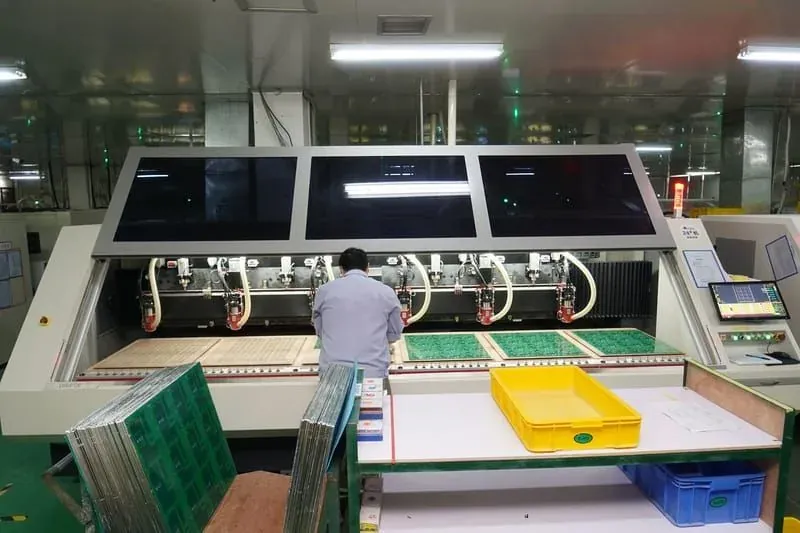
Level 2 — the production panel. The working format the fab actually processes: the thing
that enters imaging, lamination, drilling, plating and surface finish as one piece. Cost is
incurred per pass of this item through each process step. The microvia drilling time, the
lamination cycle, the plating load, the AOI pass — all of it is spent on the panel, not on
your board.
Price per board is therefore a division problem: panel cost divided by the number of good
boards that panel yields. Anything that reduces how many of your boards fit on the panel
raises your unit price, even when your board itself has not changed by a single mil.
This is why two suppliers quoting the same Gerber can legitimately differ. They are not
disagreeing about your board. They are working with different answers to a question you did
not ask: how does this board get laid out, and what does it ship as?
Where the usable area goes
Panel area gets consumed by things that are not your circuit. Each of them is a decision, and
each one has an owner.
Process border. The panel perimeter that carries the material through handling and
plating. It is not optional, and it is not part of your board. A panel layout that needs a
wider border for your build fits fewer boards.
Tooling and handling features. Location holes, tooling holes, and the clearances around
them. These serve registration through a multi-cycle HDI build, and on sequential builds there
is more registration to serve than on a single-lamination board.
Test and process coupons. Impedance coupons, plating thickness coupons, reliability
coupons. Whether these exist is your call, not an inevitability. If your specification
calls for coupon-based evidence, those coupons occupy panel area and that area is in your
price. This is a legitimate cost — you are buying evidence — but it should be a cost you chose
knowingly rather than discovered afterward.
Spacing between units. Set by how the units get separated. More on that below, because it
is the one buyers most often hand over without realizing it.
None of these is waste. All of them are area you are paying for. The point is not to minimize
them blindly; it is to know which ones your own document put there.
The shipping unit is an RFQ field, not a fab preference
Here is the field that goes blank most often: what does one delivered item look like?
A single board? An array of boards held together in a frame? If an array, how many rows and
columns, in which orientation, with what overall outline?
When you do not say, the supplier decides — reasonably, from their own process window and
their own assumptions about your downstream assembly. And they are guessing at something only
you know. The array format is driven by your assembly line: feeder width, conveyor rails,
fixture geometry, whether the board gets hand-placed or runs through a reflow oven on a
carrier. The fab cannot see any of that.
Two failure modes follow from leaving it blank, and the second one is worse:
- The quote is not comparable. Each supplier priced a different layout. You compare the
numbers anyway.
- The array arrives wrong for your line. Now it is not a price problem, it is a schedule
problem — re-layout, re-tooling, re-quote, and the lead time starts again.
The second one is the expensive one, and it is the one that is entirely preventable with one
paragraph in the RFQ.
Separation method decides the spacing
How units come apart determines how far apart they must sit, which feeds straight back into
how many fit on the panel.
- V-cut (scoring). Cuts along straight lines across the full panel width. Units sit close
together, which is good for utilization, but it constrains you to rectangular outlines on
continuous lines, and it puts a scoring groove through material adjacent to your circuit.
- Routed slots (tab route). A cutter path around each outline. Handles non-rectangular
shapes and internal cutouts, and keeps the cut away from your circuit edge. Costs you the
cutter width plus clearance on every side of every unit.
- Perforated tabs (mouse bites). Small drilled tabs that break by hand or in a fixture.
Flexible on outline, but leaves a break-edge condition at each tab that someone has to
accept or reject.
The pattern is consistent: **methods that let you place units closer together constrain your
outline and move material near your circuit; methods that free your outline cost you
spacing.** There is no option that is simply better. There is only the one that matches your
outline, your edge requirements, and your assembly handling — and that is a decision with your
name on it, not the fab's.
Edge condition after separation is a separate acceptance question, covered in
board edge depaneling acceptance criteria.
Settle the method here; settle what an acceptable edge looks like there.
The RFQ fields that make quotes comparable
Add these to your HDI RFQ. They are short, and they remove most of the unexplained spread.
| Field | What to state | Why it moves price |
|---|---|---|
| Individual board outline | Dimensions and shape, including internal cutouts | Baseline area |
| Shipping unit | Single board, or array | Decides the unit of delivery and handling |
| Array rows × columns | Explicit count and orientation, if array | Fixes the layout instead of leaving it to default |
| Array overall outline | Maximum envelope your assembly line accepts | Prevents an array that does not fit your line |
| Separation method | V-cut / routed / perforated tab, or "supplier to propose" | Sets required spacing between units |
| Process border | Required or supplier-determined | Consumes panel area |
| Coupons required | Which coupons, and whether they ship with the order | Area plus test cost, chosen by you |
| Fiducials and tooling holes | On unit, on frame, or both | Driven by your assembly, not by fabrication |
| Panel utilization disclosure | Ask the supplier to state it with the quote | Makes the area basis visible and comparable |
The last row is the one that changes the conversation. Asking a supplier to state the
utilization basis alongside the price turns an opaque number into a number with a denominator
you can check.
If you want the full document set this sits inside — what belongs in the data package before
any of this can be quoted — see
the HDI PCB quote package checklist.
Three questions to ask when quotes still differ
You declared the fields and the prices still spread. Ask these, in this order.
1. "What panel format did you quote this on, and how many units per panel?"
If two suppliers report different unit counts after you fixed the array, the difference is in
their panel format or their border and spacing rules. That is a real capability difference, and
it is legitimate. Now you can see it instead of guessing at it.
2. "Which of the area consumers in this layout came from our specification?"
Separates what your document caused from what their process requires. Coupons you asked for
are yours to keep or drop. Border width their process needs is theirs. You can only trade away
the first kind.
3. "If we changed the array format, what would move?"
A supplier who can answer this quantitatively for their own process is telling you something
useful about how well they understand their own cost structure. One who cannot has given you a
price without a basis.
Supplier capability tiers interact with all three answers — a shop with a tighter process
window places units closer. That comparison is in
HDI PCB manufacturing capability tiers.
Lock it into the document
Verbal alignment during quoting does not survive into production. The array format, separation
method, border treatment and coupon requirement belong in the fabrication specification that
the purchase order references — not in an email thread.
A specification that names the shipping unit is a specification that cannot be re-interpreted
on the second order. One that omits it hands the decision back to whoever builds the panel
next time, and the next panel may not be built by the same person. See
how a fabrication specification sheet binds the quote.
Shipping unit and separation method are the two most commonly omitted fields on an HDI RFQ,
and they are the two that most reliably explain price spread. Write them down.
FAQ
Is panel utilization something I can control, or is it the fab's business?
Partly yours. Your board outline, array format, coupon requirements and separation method all
feed into it, and all four are your declarations. The panel format itself and the process
border are the fab's. You control your half by declaring it instead of leaving it to default.
Should I just specify the array format that gives the best utilization?
No. Specify the array format your assembly line needs. An array that maximizes panel fit but
does not run on your line costs you far more in rework and re-tooling than the area saved. Let
utilization be an outcome of a correct array, not the thing you optimize first.
Why do suppliers not state utilization in their quotes by default?
Because it is not normally asked for, and because it exposes a cost basis most quotes keep
implicit. Asking for it is reasonable and most suppliers can provide it. The answer is more
informative than the price.
My board is small. Does any of this matter at that size?
More, not less. On a small board the area overhead per unit — spacing, border share, coupon
area — is a larger fraction of what you pay for. The smaller the board, the more of its price
is overhead geometry rather than circuit.
Can I leave the separation method to the supplier?
You can, if you write "supplier to propose, buyer to approve." That is a declared handover
rather than an omission, and it keeps the decision visible. What you should not do is leave
the field blank and discover the method on delivery.
Does the array format change my part number or my acceptance criteria?
It can change what one delivered unit means, which affects counting, packaging and incoming
inspection. Decide whether your acceptance applies to the individual board or to the array
before the first delivery, not during it.
Need PCBs for Your Project?
Get an instant quote — prototypes from $2, delivered worldwide.
Get Instant Quote