Heavy Copper PCB Prototype: What Your Sample Order Already Locked In for Production
The sample order is not only a technical trial
Most buyers treat a heavy copper prototype as a question with one answer: does the board work. So the sample PO gets written loosely on purpose — a copper weight, a layer count, an outline, "standard" for everything else — on the assumption that production is a separate negotiation that starts from a clean sheet.
It does not start from a clean sheet. By the time the sample ships, a set of decisions has been made by someone. If you did not make them, the fabricator made them for you, reasonably and silently, to get your board built. Those choices become the reference for the production quote, the reference for what "same as sample" means, and the reference nobody can revisit later without a price change.
That is the practical problem this article addresses. Not whether a prototype is possible — PCB168's heavy copper page publishes 3oz to 20oz copper on 1-16 layers, 0.8mm to 6.0mm thickness, and states that prototypes are *typically* shipping in 3-5 working days. The problem is which lines on the sample order become irreversible, and how to write them so the production quote you get back is on a basis you chose.
Two columns: what the sample stage freezes, and what it does not
Before going line by line, it helps to see which decisions travel and which genuinely reopen. The distinction is not about importance. It is about whether changing the item later forces a requote, a retooling, or a new qualification.
| Input | At sample stage | Carried into production |
|---|---|---|
| Copper weight and which layers carry it | Set once to build the sample | Yes — changing it changes etch, lamination and price |
| Layer count and board thickness combination | Chosen to fit your stackup request | Yes — the combination, not each number alone |
| Minimum line width actually used | Often pushed close to capability to fit routing | Yes — and it becomes a yield cost at volume |
| Surface finish | Picked to get a solderable sample | Mostly — assembly and shelf life assumptions follow it |
| Panel form, process rails, separation method | Decided by the fabricator unless you specify | Yes — panel utilisation is a cost driver |
| Impedance or electrical requirement | Applied only if you asked | Only if it was written down |
| Inspection and test records | Produced only if requested | No — unrequested records cannot be reconstructed later |
| "Sample approved" | A verbal or email conclusion | No — not binding unless bound to a document |
The last two rows are the ones that cost real money. Everything above them can be renegotiated at the price of a requote. Records and approvals cannot be renegotiated at all, because the boards they would have described are already gone.
Copper weight: "6oz" is a sample answer, not a production specification
Writing *6oz heavy copper PCB* on a sample order is enough to get a sample. It is not enough to get a comparable production quote, for two reasons that only surface at volume.
The first is layer position. On a multilayer heavy copper board, outer and inner layers are not built the same way and do not cost the same. A specification that names one copper weight for the whole board leaves the fabricator to distribute it. Whatever they chose for your sample is now the reference — and if a second supplier distributes it differently at production quoting, the two prices are not comparable even though both say 6oz.
The second is measurement basis. Copper weight can be read as base copper before processing or as finished copper on the delivered board, and the difference is not cosmetic on heavy copper work. PCB168 has a dedicated piece on that distinction in finished copper thickness versus base copper in the PO; the point here is narrower. At sample stage nobody argues about it, because there is one board and it either works or it does not. At production stage it becomes an acceptance criterion, and if the sample was never declared on a stated basis, you have no baseline to hold anyone to.
So the sample order should already read as a per-layer statement with a measurement basis, even when you only want three boards. Not because the sample needs the rigour, but because the sample becomes the definition of "same as before".
The 6mil minimum line width means two different things
The heavy copper page publishes a 6mil minimum line width. At sample stage that number reads as a capability limit: can my routing fit. At production stage the same number reads as a cost and yield position: how much margin is left when the same board is built thousands of times.
The difference matters most for the signals that are not carrying current. A heavy copper design usually has two populations of traces — the power paths that motivated the thick copper, and the control, sense and feedback signals that have to coexist with them. If the sample was routed with control signals sitting at or near 6mil because that was the only way to fit them, the design has no margin left, and production yield becomes the fabricator's problem to price.
There are two honest ways out, and both are cheaper to take at sample stage. Either give the control signals real clearance by revisiting the layout while it is still cheap to change, or accept the tight routing knowingly and ask what it does to the production price before you approve the sample. What does not work is discovering at volume that the board only ever fit by using up all the available margin. If you want the underlying reasoning on how copper weight, layer count and thickness constrain each other, thick copper multilayer layer count limits covers that ground; here the question is only whether your sample used up margin you will need later.
The panel is a decision, and the sample already made it
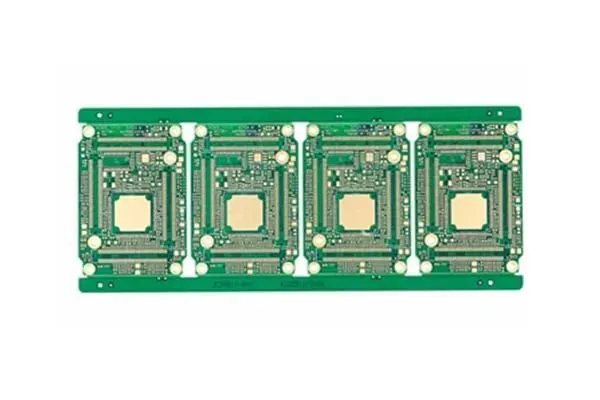
A prototype arrives as a panel: several identical units on one piece of material, with process rails along the edges and the units separated by routing or scoring. That form was chosen by someone. If your sample order did not specify it, the fabricator chose the arrangement that suited building three boards.
Panel utilisation is a production cost driver, not a sample detail. How many units fit on a working panel, how much rail the process needs, how the units come apart and what that leaves on the board edge — these carry directly into unit price at volume. The capabilities page publishes a maximum board size of 600mm × 1100mm, which sets the outer bound, but the arrangement inside that bound is where the cost sits.
Two consequences follow. First, if you plan to assemble the boards yourself or through a third party, the panel form is an assembly input as much as a fabrication one, and it should be agreed before the sample rather than inherited from it. Second, if the production panel is arranged differently from the sample panel, the delivered boards can be legitimately different at the edges while still matching every line of your specification. PCB168 covers the edge side of that in board edge depaneling acceptance criteria; the transfer question is simply whether you approved a panel form or merely received one.
Lead time: the sample number is not the production number
The heavy copper product page states that prototypes are *typically* shipping in 3-5 working days. That figure is useful and it is also strictly a prototype figure, qualified by "typically" on the page itself. It says nothing about production lead time, and treating it as a proxy is one of the more common ways a schedule goes wrong after a successful sample.
Production lead time is a separate question with separate inputs, and the sample stage is when to ask it: what is the lead time at the quantity you actually intend to order, what does it depend on, what changes it, and when does the clock start — at PO, at file approval, or at first-article approval. The last one matters more than it sounds. If the clock starts at first-article approval and your own approval loop takes a week, that week is yours, not the supplier's, and it belongs in your plan.
Ask all of this while the sample is in progress. Asking after approval converts a planning question into a pressure question.
Four records you have to request before the sample is built
This is the section that cannot be fixed retroactively, so it is worth being blunt: records describe boards. Once the boards are built and shipped, the records that were not produced cannot be produced. There is nothing left to measure.
The capabilities page publishes the inspection and test methods available: AOI on every layer, 100% electrical test by flying probe or fixture, TDR coupon verification for impedance, microsection for quality validation, X-ray for BGA and via fill, and ionic contamination testing per IPC standards. Availability is not the same as inclusion. For a heavy copper sample intended to become a production part, four of these are worth requesting explicitly:
- A first-article report that states what was measured and against what criteria — not a pass/fail line, but the values and their basis. This is the document that gives "same as sample" a meaning.
- A microsection of the sample. On heavy copper work this is the only evidence of what actually happened inside the board — how the plated holes connect to thick copper layers, how the dielectric filled between heavy features. You cannot section a board you have already installed.
- Electrical test records for the sample units, so that a failure at your incoming inspection later can be separated into "arrived faulty" and "became faulty".
- A material declaration naming the laminate actually used. The product page lists FR-4 TG170/TG180 for heavy copper; the declaration ties your sample to a specific material so a production substitution is visible rather than invisible.
If budget or schedule forces a choice, the microsection is the one to protect. It is the least reconstructible of the four.
"Sample approved" needs three things attached to it
An approval that exists only as an email saying the sample is fine is not a production commitment. It is an opinion about three boards. To make it carry, bind it to three things:
- The criteria document. Approved against what? A named specification revision, or the first-article report values. Without this, "approved" means "nobody complained".
- The sample identity. Which units, from which panel, built to which file revision. A sample approval that does not identify its own samples cannot be used as a reference later.
- A change notification obligation. Who tells you, and before or after the fact, if material, copper distribution, panel form, finish or process route changes between the sample and production. This is the clause that makes the other two enforceable.
Without the third item, the first two describe a board that may no longer be what you are receiving. PCB168's heavy copper coverage goes deeper on the evidence side in heavy copper supplier process evidence requests and on the specification side in heavy copper purchase specification and acceptance. Both assume you are at one stage. This section is about the seam between two.
A sample RFQ paragraph you can adapt
The page asks you to "send your stackup and current requirements for a manufacturability review before you commit to production", and the quoting flow works from your Gerber files. The following is a paragraph to add alongside those files so the sample is quoted and built on a basis that survives into production. Adjust the bracketed items.
> This is a prototype order intended to transfer to production at approximately [quantity] per [period]. Please quote and build on the following basis. Copper weight: [value] on [which layers], declared as [base / finished] copper. Minimum line width used on control and sense nets: [value], with [value] clearance to power features. Board thickness [value] at [layer count]; laminate [named grade]; surface finish [named finish]. Please state the panel arrangement, process rail allowance and unit separation method you intend to use, and confirm whether the same arrangement would be used at production quantity. Include with the sample delivery: a first-article report stating measured values and their criteria, one microsection, electrical test records for the delivered units, and a material declaration naming the laminate used. Please also quote production lead time at the quantity above, state what the lead time is measured from, and confirm that any change to material, copper distribution, panel form, finish or process route between this sample and production will be notified in writing before it is made.
That paragraph is deliberately not a specification. It is a set of instructions about which decisions you want made explicitly rather than by default.
What this changes about the quote you get back
Three things, in order of how quickly you notice them.
The sample quote may take a little longer to come back, and may carry a small addition for the records. That is the cost of having a baseline. The production quote, when it arrives, is comparable — to your own expectation and to a second supplier's number — because both are answering the same specification rather than each supplier's reasonable interpretation of a loose one.
And the transition itself stops being a renegotiation. "Same as sample" has a document behind it, the sample has an identity, and a change on the supplier's side is something you are told about rather than something you discover at incoming inspection. For the incoming side of that loop, the incoming inspection acceptance plan covers how to define sampling and reject criteria for the delivery itself.
If you are starting from current and temperature rise rather than from a copper weight you already chose, work that out first — deriving copper weight from current and rise is the upstream step, and this article picks up once you have a number to put on a sample order.
Related reading on PCB168
- Heavy copper PCB purchase specification and acceptance evidence
- Deriving copper weight from current and temperature rise
- Thick copper multilayer PCB layer count and copper weight limits
- Finished copper thickness versus base copper in the PO
- Incoming inspection acceptance plan for PCB delivery
- Heavy copper PCB product page · Manufacturing capabilities · Request a quote
---
FAQ
Should I really specify copper weight per layer for a three-board sample?
Yes, and it costs you nothing but a sentence. The sample becomes the reference for "same as before" at production. If the distribution was never stated, the reference is whatever the fabricator chose, and a second supplier quoting production may distribute it differently while quoting the same nominal copper weight.
Can I request a microsection after the sample has been approved?
Not of those boards. A microsection destroys the sample it is taken from, so it has to be planned as part of the sample build. Sectioning a later board tells you about the later board, not about the one you approved.
Does the 3-5 working day prototype figure apply to my heavy copper board?
The heavy copper page states prototypes are *typically* shipping in 3-5 working days, with "typically" doing real work in that sentence. Treat it as a prototype-stage indication, confirm it for your specific build during quoting, and ask production lead time as a separate question — the two are not related.
Is 6mil minimum line width a problem for my design?
Not by itself. It becomes a problem when the sample only fit by routing control signals at or near that limit, because there is then no margin left for production yield. Check what width your control nets actually ended up at, and decide knowingly rather than discovering it at volume.
What if the supplier says the panel arrangement is their internal decision?
It is their process decision, and it is also a cost driver and an assembly input. You are not dictating it — you are asking to be told what it is and whether it changes at production quantity. A supplier who will state it is giving you a comparable quote; one who will not is giving you a number.
Which single record matters most if I can only request one?
The microsection. The other three can be partially reconstructed or substituted — a later report, a later test record, a material declaration after the fact. Internal structure evidence cannot be recovered once the boards are in service.
Need PCBs for Your Project?
Get an instant quote — prototypes from $2, delivered worldwide.
Get Instant Quote